We all went on that strange, crooked pathway called life. No one took a path that quite matched what they expected or what anyone else expected for them. Some paths were radically surprising, some merely crooked. Some triumphant, some quotidian.
My goal is to become the authoritative source for information that means nothing at all.
Sunday, June 19, 2011
Forty And Looking Back
We all went on that strange, crooked pathway called life. No one took a path that quite matched what they expected or what anyone else expected for them. Some paths were radically surprising, some merely crooked. Some triumphant, some quotidian.
Wednesday, February 23, 2011
Confessions of a Tomato Hater
Sunday, February 20, 2011
My Urban Homesteads
Thursday, February 17, 2011
An Open Letter to the Dervaes'
Well it is a mighty fine mess you have created. Yes, Dervaes family, urbanhomestead.org, you have really managed to do something profound to the community you helped create.
You have chosen to trademark a whole host of terms, ostensibly seeking to protect them from those who would misuse and abuse them for their own profit. I’ve got some respect for this – after all, it is easy enough to imagine the Monsanto Urban Homesteader collection of seeds or the Lowe’s Urban Homesteader Twice-A-Year Sale.
Unfortunately, there are a couple of problems with this.
First off, you weren’t there first. A quick bit of online research finds the phrase “urban homestead” in some variation or the other dating back to the 1970s or before. But the legitimacy of your claim isn't the greatest issue here.
The urban homesteading movement (by whatever name you wish it to go by) is a tenuous thing. We are decentralized. We come from a range of social, political, and moral backgrounds. We’ve come to this for a variety of reasons: health, environment, economics, survival, enjoyment. We practice in varied ways as suit our varied natures and regions: poultry, fruit, vegetables, livestock, dairy.
We run the risk of appearing as freaks and finding ourselves further marginalized just as we are gaining traction and awareness.
So here we stand, not on the cusp of victory by any means, but on the cusp of moving to a greater playing field. The values we espouse are being picked up by authors, chefs, and social commentators and spreading to an ever broader audience. The tools and supplies we need are available more easily as more and more people show an interest in a backyard orchard or some raised beds or a chicken coop. Laws are making it easier for us to practice what we believe in (I’m talking about how my town repealed a ban on backyard poultry last year…but I’m sure there are others).
Just as things start to take off, do we really want to risk going from respect to mockery? Think of it this way: which headline would you rather see CNN or The New York Times run next week?
In yards around the nation, Urban Homesteading taking off!
Or
Urban gardens taking off, but don’t call them homesteads!
Do we want to risk drifting into that part of the news day usually called “the lighter side” where mainstream America pokes fun (often deservedly) at people who lie just a little too far outside the bell curve or normality?
Perhaps even more critically, do we want to see the common idea that binds us together torn asunder because of the lack of a word, an all important linguistic thread that weaves between all of our diverse backgrounds, motivations, and interests? For words have meaning and power well beyond their superficial sounds and definitions. They provide identity, meaning, and community. They define and establish boundaries of inclusion and exclusion. Their proper use is a Shibboleth demarking true believers from tourists and pretenders.
Do we want to risk Balkanizing ourselves into urban homesteaders, city farmers, metropolitan agronomists, backyard growers, and the hundreds of other permutations I could devise, each one separated by a shade of meaning, a subtlety of belief or background or motivation? “Oh no, I’m not a city farmer, those are people with apartments. I’m a metropolitan agronomist because I practice square-foot techniques outside of the city core.”
Hyperbole on my part? Yes, but exaggeration and humor to make a point.
So perhaps, Derveases, we misunderstood you and your intentions were pure if ill communicated. Personally, I don’t think you were trying to shut down the use of the words Urban and Homesteading. I think you were trying to drive site (and store) traffic by intimidating bloggers, libraries, and authors into offering you a credit and a link. But my suspicious are beside the point.
Your blog posts and tweets profess surprise at the community’s reaction and accuse those of us with some spleen to vent of misunderstanding your intentions. They read accusingly, saying that this misunderstanding is our fault. They make us feel bad for the hurt they have caused your family, the tears brought on by our impassioned words.
Then why, I ask, were your first attempts to control the use of these terms targeted at a library and a blogger? Why do you respond with a series of defensive tweets and a blog update that cries out how hard this has been on you?
Welcome to the big time, Urban Homestead. Success is a bitch, that high profile you’ve worked to build up means there are a lot of people watching you – but that’s what you wanted, right? You came across as the big bad, swinging a legal claim, no matter how indefensible it may be, to get your way and get your due credit. People reacted in a way you didn't expect (really?), in a way that hurt you.
And the result has been bad, very bad. Whether you intended to deny use of these terms to the community at large or not, that is how we have understood your actions. And that is what is driving our reaction.
The point is that your actions, however they were intended, have jeopardized the movement you helped spawn. Your intentions are irrelevant. The results of your implementation and the broader community’s perception of that implementation are what matter – and the perception of that perception, but I risk losing my way. You have children and so know that intentions count for only so much. Results, whether those intended or expected or not, are what matter. And so you must choose your future actions based not around your professed or actual intent but around the reality in which you find yourself – an unpleasant reality with no easy choices.
And it is by those actions that the rest of us urban homesteaders, who owe you so much, will judge you and assess your intentions.
How should you react now that you’ve enraged a good portion of the community? Your blog and tweets profess surprise at this reaction, accuse us of misunderstanding your intentions.
I’m going to assume that you genuinely believe in the movement of which you have been such a part and that you have the best interest of that movement at heart – and you should, for to try to put your own business success ahead of that of the movement at large is to jeopardize not only your relationship with the movement but the very success of the movement itself. And I hope that you recognize this relationship and do what is best not for your own short-sighted gain but rather for the continued growth of this community and your relationship with it.
What you need to do is take charge of this situation. Yes, I said take charge. After accusing you of heavy handedness (intentional or not) why do I say you should take charge?
Because you have a window of opportunity to try and save some face. You will never regain the full respect you had in the community, but that’s done. Time for damage control, time for clear words and clear actions. Time to do things that will not be misunderstood (again).
Cede the word to the community.
Stand up and in clear simple words admit that you erred:
Say “we never intended to deny the broader use of these words.”
Say “but unfortunately our actions were misunderstood.”
Say “we never anticipated the depth of feeling our actions would arouse.”
Say “but observing the passion of the community we helped foster is as gratifying as it has been troubling.”
Say “and so we waive our claim to these trademarks.”
Say “we recognize that these phrases are something larger than our family and our farm.”
Say “these words are our movement and they are your movement.”
And then shut the hell up.
We will have our community. There is the risk that these words will get misused, co-opted. But we do not need your protection and we know what an urban homestead really is without your oversight and editing.
As it stands right now, your website leaves you an opening. Make that promised press release a thing of nobility, of admission, and of generosity. Play it right and you might even come out looking pretty good.
I fear that you will take one of the easier paths. Perhaps you will take the easiest, that of stepping away from the issue, never following up on your letters, of hoping that things die down. And they might. Your reputation will never rebuild, not with those of us who live at the core of this movement. We’ll make jokes. We’ll refer to someone as “pulling a Dervaes” when they try a petty trade marking or some cheesy legal intimidation.
There is another path I fear, one that is harder for you and worse for the community. It is the path of pride, of stonewalling and digging in. Of perceiving the community’s response as some sort of a threat to some position of hierarchy that you believe you deserve. This is the path that leads to mockery of our movement, of factionalized collapse into urban homesteaders vs. metropolitan farmers vs. city gardeners. This is the path that leads to a legal fight you will not win, that will only drain your finances and threaten your very livelihood.
So I ask you, think it through. Make a decision, a tough decision. Retake what you can of the leadership you had in this community. Give us that community, without a fight, without shame, and without guilt.
As I write this, your latest blog entry is "we are urban homesteaders." I do not deny that. But so are we.
UPDATED 2/18/2011
For starters I want to thank everyone for their kind comments. I'm glad I could help lend some voice to everyone's emotions.
I deliberately tried to keep the issue of the legitimacy of the Dervaes' claims - whether legal or moral - out of this. For starters the two are quite different - they might legally be able to maintain control over a trademark that we do not feel they morally should be able to. But more than that, I'm no lawyer and while my experience around issues like this gives me some opinions and expectations, I don't want to put my foot in it by delving into idle speculations.
In the meantime, as well, the promised press release is out. It offers (a little) more information about their intentions, but generally continues the theme of "we didn't do what you are saying we did" that permeated the output from urbanhomestead.org on 2/17. Granted, it is in nicer language and they fixed some of the grammar problems (yes, I get irritated at tweets with grammar or vocabulary mistakes, that's one of the side effects of having a BA in English).
It still, however, misses a crucial point: what do you INTEND to do. They deny filing legal actions, however "informational letters" are typically a prelude to some other sort of action. They do not mention the DMCA requests to Google. It continues a disingenuous attempt to portray them as victims of a disproportionate response to innocent actions. It will do little, if anything, to quell the communities reaction.
What is made clearer is that the Dervaes family views the growing popularity of this movement as a threat to their perceived position of leadership. Too soon, guys, too soon. Yes, the time will come for squabbling and internecine fighting, but that time is not now. We are still in the "a rising tide lifts all boats" stage where supporting the greater cause will build the market. This attempt to gain control may help build market share but controlling a larger portion of a smaller or more slowly growing market is not advantageous in an absolute sense.
Pyhrric victory, anyone? A scorched earth retreat across the burning fields of urban homesteads is not the way to maintain position.
Right now we are still growing, still need to build community and identity. I work in an industry that is at market saturation and so we see crazy legal actions all the time, companies claiming too have invented whole ideas. Why? Because everyone already wants a cell phone. Every one knows what they are. Everyone wants one. So the bickering begins.
But imagine if, in the 1970's Bell Labs had trademarked the phrase "Cell Phone" and variants and then, in the 1980's when the devices started to become popular, chosen to protect that trademark. Things might have turned out differently if we had lacked a common phrase to describe that thing that we hold up to our ear to talk on when we aren't at home. Granted, there are dozens of synonyms (including bizarre new ones like "converged device"...I mean...really?) but the term "cell phone" got us started.
On Facebook, I've contrasted the Dervaes' attempted actions with Charlie Papazian, one of the founders of the American homebrewing movement. His first book came out in 1976 - homebrewing in the US wouldn't be legalized until two years later, by the way. For a couple of decades, he had the only continuously in-print book on the topic. Of his seven published books, the canonical The Complete Joy of Homebrewing
has run to thee editions and nearly a million copies sold. And then there are the six other books he wrote... Papazian is revered as a guru, a founder, an inspiration. I actually don't particularly care for his writing (a little too 1970's "relax and have a homebrew for me...I like a little more microbiology in my beer books) but if I ran into him at a convention (and if I could get through the rings of people looking for his autograph, opinion, photo op, etc.) I'd shake his hand and know I'd touched someone without whom my hobby may not exist.
Yet he, despite having at least as much right to claim ownership of homebrewing as the Dervaes' do of urban homesteading, never made any move to protect that claim. Perhaps it was that 1970's "relax and have a homebrew" attitude. Instead he threw his weight into growing the movement as a whole, founding organizations, writing books, promoting the entire idea. And now, like I said, guru status and a million books out there.
Compare and contrast. And remember, a rising tide lifts all boats. Take care of those around you and they will take care of you.
You, Dervaes' are in the unenviable position of needing to react to a situation that is now well and truly out of your control. You are dealing with a cluster f@ck you did not intend to create. But no one intends to create a cluster f@ck. They just happen. By definition, this is a self destructive situation with no easy, cost free solution. No outcome will wind the clock back a week. No outcome will be to everyone's satisfaction.
Perceptions are reality and you cannot continue to react to the message you intended to send , whatever it was, with your informational letters and DMCA requests. You must react to the message that was perceived by the community at large. Only by doing so can you bring this situation back under control.
So I ask you to make the tough call, show true leadership within this community, show that your intentions have the best interests of the community at heart, regain as much respect as possible within this community. Take the path I outlined, cede these trademarks. Let your actions be ones we can celebrate as a growing community - not ones that are derided and mocked to our shared suffering.
But now with that said, the urbanhomestead.org blog does make the point that we've all got crops to water, goats to feed (I don't, not yet), eggs to collect (ok, I don't actually have eggs to collect either...yet), retaining walls to build (I actually DO have that on my project list) and all the rest.
I appreciate all your kind comments on the original version of this open letter and, as with many of you who have commented, hope that it finds a receptive audience in those who most need to read it.
Wednesday, March 31, 2010
Just What Is "Drinkability"?

I know, for a guy who doesn't even have cable (and lives in a valley, and so doesn't get a meaningful broadcast signal), I manage to see a shocking number of ads for this stuff. I blame streaming network television, of course, and the Biggest Looser marathon I indulged in while stuck home sick.
But seriously, every twelve minutes I was inundated with an advertisement proclaiming a new beer offering the refreshing taste of wheat with the drinkability of Bud Light.
Ok, I have some idea of what the refreshing taste of wheat is. Wheat in beer, of course, because last time I sat down with a mug full of freshly husked wheat and tried to drink it I severly lacerated my moutn. Well not really. But you get the idea.
In a true beer (a statement that seems to imply that Bud Light Golden Wheat is not a true beer), wheat adds a slightly sweet graniness. I always find that beers with a high wheat content posess a slightly astringent quality, similar to the dryness of a very highly fermented beer. I don't know what causes this sensation, but it seems to naturally balance the malty sweetness that comes from the wheat malt itself.
Anyway, I don't as a rule go for beers with a very high wheat content, but have really enjoyed working with it as a component to add a little "something special" to everything from IPA's to light ales.
But I digress.
This was about bashing Budweiser.
But I don't think so. I think that what they are saying is this:
Yes, "drinkability" is essentially a statement of conformity to the general flavor profile of what we hombrewer's like to call ALL's -- American Light Lagers.
Trying new things always carries a risk. Because, after all, if we spend the energy (time, money, emotional cost) to do something out of the ordinary (say trying a new beer or throwing ourselves out of an airplane with only a rolled up piece of nylon stuffed into a backpack to slow us down), we are investing in that experience. In general, people tend to prefer favorable experiences. It takes a fairly dedicated person to have an unplesant experience and then want to go back for more.
Take, for example, the movie Avatar. I didn't like it. After seeing it, while I was glad that I'd done so (and therefore gotten to partake in the whole big deal). But I did look back on that evening and think that perhaps something better might, ultimately, have been a better way to go. On the way home, my wife and I ended up stopping at a Red Robin and consuming a large amount of spicy chicken wings just so we'd be able to point to something enjoyable about the evening.
So perhaps the same thing could apply to beer. "Hey," says Joe Sixpack, "I've heard of these new craft brews. I should try one." So Joe goes out and buys a sixer of something tasty. Who knows what...let's assume he isn't really into the subtle (or not so subtle) differences between a Maibock and an IIPA. Perhaps he ends up with a few bottles of Old Rasputin or Dogfish 120 or perhaps with something as prosaic as a Mirror Pond. Let us suppose that Joe dislikes this beer. I wouldn't be surprised if this were to happen -- no disrespect to Joe -- because the entire drinking experience would be wildly different from what he'd expect. Hell, a bottle of Dogfish 120 has been known to send experienced beer aficionados to therapy for weeks. Even if he chose something less extreme it would probably not be a light, thirst quenching, (dare I say) "drinkable" beer. Probably something meant to be consumed more slowly, to be savored.
Friday, July 17, 2009
40 years ago...
http://www.cnn.com/2009/TECH/space/07/17/moon.landing.hoax/index.html
And incidentally, as I write this, this article has been moved to the prime spot on cnn.com. Read into that exactly what you want to.
The article is a relatively good review of the moon-landing-hoax phenomena. Best of all, it includes a link to the YouTube video of Buzz Aldrin punching a leading conspiracy pusher. You’ve got to love a 72 year old guy who can still lay on one some crank’s chin. Glorious moment.
Anyway, what I find kind of depressing about this whole phenomena isn’t the fact that this amazing piece of history (by the way, I DO believe that we landed on the moon) is being attacked. Fine, go ahead, people, and believe your conspiracies. I can go on at great length about why I think people love conspiracies and so on, and will always recommend Foucault’s Pendulum as a good work about the appeal of such ideas (though the book is kind of a typical Umberto Eco slog at times).
What gets me, about the moon landing conspiracies in particular, is that they so dramatically discount our (humanity’s) ability to do something extraordinary. They are, in other words, profoundly depressing to me.
Most conspiracies, I find, seek to explain titanic events that were actually the result of small actions (e.g. a series of individually minor intelligence failures prevents detection of the attack on Pearl Harbor) as the product of grand and titanic forces (F.D.R. allowed/encouraged the attacks because he needed a way to motivate the American populace). I can get this – we all like someone/thing we can blame. And hanging thousands of lives on a series of minor events just doesn’t have the impact of One Dude Who Did It.
Similar theories about regarding the 9/11 attacks. All of them seem predicated on the idea that No One Could Screw Up That Bad. And they replace the series of minor errors with a Grand Conspiracy.
There is a theme here – an ugly, mundane, chaotic reality is replaced with something dramatic and populated by super-capable heroes or villains.
The moon landing theorists go the other way – and this is what I find so depressing. Instead of a massive, concentrated effort by thousands, pushing technical and human limits, the conspiracy theorists would drag that success down to the level of some 2nd rate work on a sound stage.
It is a sad rejection of the capabilities of humanity to take such an achievement and, in the face of all evidence, reject it.
It is a sad, mediocre mind that can only find a sense of worth by bring others down to their level.
It is a sad commentary that (some) people find it easier to subscribe to a "vision" of mediocrity than to a reality of audacious achievement. Is that number increasing (as the article claims it is) because time is passing and a younger generation (understandably) finds it hard to imagine a world, 40 years gone, where humans could walk on the moon? Or is it increasing out of a gradual settling of goals and visions, a drooping of expectations and efforts from struggling for grand, shared visions to a selfish assumption of ease and entitlement?
Yours, in hope of audacity, that we may remember and recognize what we all (and all of us) are capable of.
--Nick
Sunday, May 17, 2009
Boldly going...or is it going boldly?
15) Has the courage to split the infinitive and go with the original "to boldly go" construction. FYI, I am with that faction of writers and grammarians (probably because I am more writer than grammarian) that accepts that in certain situations a spit infinitive is an entirely acceptable thing to do and may, in fact, have dramatic, narrative, or stylistic advantages (such as here, where "boldly" gets more emphasis by virtue of its placement).
14) Captain Pike shows Kirk up as a girly man. More seriously, I liked the contrast between the old (but somewhat free thinking) commander and the young (and entirely free thinking) commander. Pike is what Kirk will become after he cooks for a few years...and Pike I suspect sees Kirk as what he was like before he'd had a chance to cook himself.
13) No Borg. I was afraid that they'd try to have some Borg backstory going on -- they are a fantastic enemy but are very much a product of the latter instances of the show. And besides, First Contact already did a pretty strong time-travel-Borg themed story (and did it very well).
12) The alternate-history reboot meant that I actually thought some of the principle characters might die. Gone was the easy ability to predict which characters would live and which would die.
11) Speaking of alternate histories, they avoided the "and the boy woke up" conceit and decided to stick with the new history that they created, rather than having some dramatic event result in a bright flash of light and a cut to some scene that made it clear that we were back in the traditional Star Trek history (e.g. Kirk graduating from the Academy with his father proudly looking on).
10) Speaking (more) of alternate histories, I applaud the decision to "reboot" the show. Just as Casino Royal did for the Bond franchise, it is sometimes necessary to clear the decks and start from scratch. The Star Trek timeline had grown so polluted with interpretations, inconsistencies, and conflicts that this was an almost essential move. I know many old school Trekkies were displeased (and I know some of those old school Trekkies who I know were displeased), but (don't take this the wrong way, old school Trekkies) I think there is a degree of curmudgeonly resentment, as if new Trek fans haven't "served their time" dealing with the hideous stretch polyester costumes and Shatner's bizarre speech patterns.
9) Finally breaks the "naval combat" two-dimensionality of the Star Trek space combat scenes. Granted, Star Trek II had the "he only things in two dimensions" moment, but notice that the "descending Enterprise" that ambushes Kahn was settling like some sort of blimp, and not really utilizing the third dimension. Prior to this point, the only true excursion into that wacky third dimension is in the wonderful All Good Things wrap up to The Next Generation when the refitted Enterprise is seen "flying" 90 degrees out of plane to the Klingons.
8) I honestly liked the blue collar villain. I know some weren't as taken, but for starters the guy looks and sounds remarkably like Kevin, one of the trainers at the gym where Erica and I work out (great guy, Kevin). But I really felt for this character -- here he is, some Romulan miner who'd rather just head home, have a few pints of Romulan Ale, and spend time with his family. Instead, an unspeakable tragedy (and a very human-like desire to focus his rage and loss on a single object) drives him mostly-mad and on a quest for vengeance that drives him the rest of the way mad. Quite a change from Christopher Plumber's wonderful Shakespeare-quoting Klingon General to have this plain-talking "Joe the Romulan Miner" character.
7) I was very pleased to see many of the "background" members of the principle cast get stronger stories. E.g. Uhura is now portrayed as a brilliant linguist and Checkov as a math whiz. The Original Show was pioneering for including a black woman and a Russian in the crew. Now we can actually give them some skills. And I thought that Checkov the 17 year old math whiz was actually played relatively well as a 17 year old math whiz -- somewhat geeky but not entirely so. But then again, we live in an age when even geekdom is socially acceptable.
6) I can't possibly express how pleased I am that the Beastie Boy's Sabotage continues to exist in the 23rd century and to serve as an anthem for rebellious midwestern youth.
5) Played with a lot of humor -- and a good balance of action and humor. Star Trek is not an action movie franchise, but it has always incorporated action into the stories. Primarily it has been about ingenuity and clever escapes and the power of friendship and loyalty -- something that is harder to think of and harder to execute than a good shoot-em-up sequence. All was well balanced here. And the humor was, I thought, quite wonderfully played, for Star Trek has always possessed a real wry sense of "eyebrow raising" humor. From the slapstick Dr. Strangelove homage of Kirk's "puffy hands" sequence to the generally well played "signature moment" taglines for each crew member to the dry wit of Spock, the humor was great.
4) No Shatner. 'Nuff said.
3) My favorite moon, Titan, played a significant role. The background shot of Jupiter in that sequence is, I presume, based on a Cassini shot that has often been my little MacBook's desktop background.
2) in their characterization of the original actors. Some, such as Chris Pine's portrayal of Kirk, stopped short of going all the way (e.g. avoided the speech patterns). Others, such as Karl Urban's McCoy ran with the original and gave it some added depth.
1) And the number one thing I liked about the new Star Trek: it breaks the "odd number curse" of the Star Trek films.
Top five things I don't like about the new Star Trek:
5) While most of the "young" characters had a pretty good physical resemblance to their "old" originals (this is starting to sound like the "New Originals" scene in Spinal Tap), Sulu was a pretty wide miss. It turns out (thank you Wikipedia) that John Cho (young Sulu) is Korean-American, which goes some way to explaining the differences of physical build. I'm willing to run with George Takei (old Sulu, if you are ignorant of such things) and his logic that since Sulu was stuck representing for all of Asia in TOS (and, as it would turn out, all of the GLBT community, a group for which I think Takei is one of their finest spokespeople), it was OK to show a little license there.
4) Age, a decade or so of obscurity, and a painkiller habit have not been kind to Winona Ryder.
3) The conceit of having most of the Federation fleet away fighting some action in some other chunk of space, thereby allowing for the convenient crew-of-academy-punks was a little convenient. But, then again, this is Star Trek and such convenient conceits seem to be a integral part of this universe.
2) While I generally really liked the way that the technology was portrayed (generally a little clunkier than in the "later" shows, lots of warning labels, etc., I did think that there were some points where it looked like the bowls of the Enterprise had been converted into a brewery or a winery. I actually seriously think that one scene was shot in a winery, one of those big ones with lots of stainless steel for making low grade white wine.
1) Just one too many of "Dammit, Jim, I'm a doctor, not a..."
Overall?
Fifteen points in favor, five against...most of which are moderated to some degree. I'll make it easy and just come out and say that I loved it. A very well balanced film, two hours that passed quickly and have produced a lot of good musing, thinking, and discussion afterwards. Recommended, and worth the theater trip to see it in the full spectacle. I'll be queuing up to buy the BluRay when it comes out!
Friday, May 8, 2009
The Frigate Navy Redux
But I digress from a point I have not yet started to make.
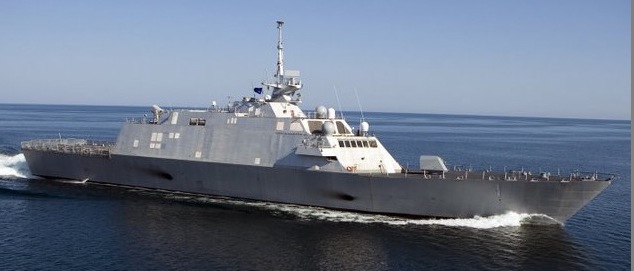
Conceptually, the LCS is clever. It is designed to offer a game changing degree of modularity, and this modularity allows for a striking range of capabilities to fit in a single hull -- without that hull getting so large that it grows unwieldy and incapable of the in-shore mission. And (perhaps more importantly these days) without having to buy enough gear to equip every hull equally. The math, at this point, seems entirely sound -- the chances of needing to simultaneously land a SEAL team, sweep for mines, and hunt submarines are pretty slim. So build a bunch of ships that can't do all of these things at once and just enough gear to go around, one kit per vessel. You cross-deck the sonar arrays depending on which ship is tasked with sub hunting. Cross-deck the minehunting robots to the needed ships, the special ops kit, etc. all as needed.
The modularity carries with it a drawback -- the fact that these modules need to be changed. I mean, what if you do suddenly need to hunt submarines? Fine, go in to port, swap out the launching ramp and the rubber boats, and the gym and barracks for the SEALS. Load aboard the towed array sonar kit. Fly off the MH-60's that were doing the special ops work and land a couple of SH-60's to drop torpedos and do sonar dips. Let the SEALS go drink some beer and bring on board some mine warfare experts. Lather, rinse, and repeat of the mission changes again.
Great plan, provided you have a friendly port nearby. And, with a bit of a flourish, the drawback to the whole LCS falls in to place. It truly is designed for the current war. By which I mean the Persian Gulf -- a place where it is never too far from a friendly port where it can meet up with a tender for supply and conversion between roles. Which also means, of course, that though capable on paper of some fantastic speeds, the LCS' true speed of deployment is limited by the rate at which logistic support can be brought over to resupply and re-role the vessel when needed.
Now modern navy's have always depended on supply lines -- and since the US Navy perfected underway replenishment during and after World War Two, the need for friendly foreign bases has been much reduced. I fear that the LCS will only take us back a stage, back to the era of the coal fired navy when allied ports were needed every few thousand miles, ready to refill the hungry bunkers of those early, inefficient vessels. Commodore Perry, anyone?
I am as optimistic as the next person that the Obama administration's policies will see a return towards the coalition building that dominated the war fighting of the past few decades -- when the US was working as a member (all be it a dominant one) of a team and could, therefore, pretty reliably count on friendly ports for its efforts. But even so, this reliance has its costs and risks. Does the USS Cole bring back any memories?
Or, to bring up a more timely situation, what about Somalia and the shindiggery going on in the waters of East Africa? More on that later.
Much of naval warfare is about maintaining presence. That is the thing, in this globalized world, that navies can do better than any other branch of the services. A ship can, in a way that no other weapon system can, simply be. It can hang out, outside the twelve mile limit and in international waters, just saying a friendly "hi." The sort of "hi" that can carry Tomahawk missiles (and therefore reach just shy of 1,000 nautical miles inland in the latest version), soak up radio and radar signals and send them back home to the NSA boffins, keep track of hostile or suspect shipping. It is the very epitome of "speak softly and carry a big stick," it is the reason the phrase "gunboat diplomacy" has not been replaced with the phrase "uncrewed air vehicle diplomacy." A warship, or a collection of them, can maintain free passage of the sea lanes that carry the overwhelming majority of the world's commerce...or close them off when blockade and embargo is the order of the day.
The United States Navy currently possess the most capable and versatile floating big sticks in the military world -- the largest fleet of (and the largest) air craft carriers in the world. There are also dozens of CG-47 and DDG-51 class cruisers and destroyers, all with exactly the sort of staying power and strike capability that I'm talking about. Boo-ya. Fly Navy.
But these are big assets -- and many are tied up in the odd sort of self-escorting that is the devil of all deployed military operations. The cruisers are busy escorting the carriers, protecting them, tending to them. All of these vessels are also forward deployed, with their unique and amazing capabilities, around countries like North Korea that have a disturbing to just go ballistic one day (pardon the pun) or fighting the couple of active wars in which we are currently embroiled. Not a lot of these high-ticket ships are left to fill in the little cracks in US foreign policy.
Like Somalia.
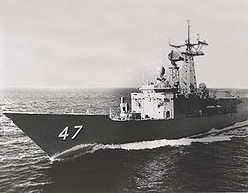
1) recapturing the first piece of Kuwait, an oil platform, and in the process capturing the first Iraqi prisoners of the war.
2) detecting and (in cooperation with a Royal Navy frigate of similar size and their embarked helicopters) sinking about a dozen Iraqi patrol boats.
3) rescuing a downed USAF pilot
4) accidentally being shot at by another USAF pilot (no harm done)
5) destroying several Iraqi laid mines
6) escorting the battleships Missouri and Wisconsin on gunfire missions.
During much of this conflict she was operating 70 miles closer to enemy shores than any other "regular" US Navy vessel. Since then she's kept on with the busy agenda. Read the Wiki page. Oh, and just to brag, ships that share my name have a bit of a history. If you really want a busy naval career, look at the 2nd USS Nicholas (the one I was just writing about was the third).
Now here's where I get to my point -- that list of accomplishments, from Iraq to Bosnia, is a litany you will find on few vessels twice her size. It is an irony of naval history that very often the big ships do not get the big missions.
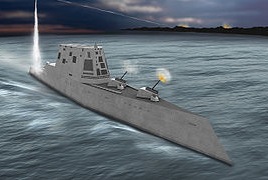
But the little ships -- the new ones, the LCS -- run the risk of simply creating more trouble by requiring more basing, more supply lines, and more reasons to maintain a presence in the first place. It is just a return to the problem of spending so many of your resources protecting and supporting your resources that we you have no resources left to actually do anything.
Do I have a solution, or am I just a crank?
Actually, I have a solution. At one level, this solution is simply "more Perrys." More medium sized vessels, handy enough to operate in the littorals, large enough to play a role in a deep ocean fight and to help with the escort needs of the 1st class navy (carriers, cruisers, amphibious vessels), affordable enough to be built in quantities sufficient to send them where needed, large enough to be self supporting for a reasonable length of mission. Part of what made the Perrys such versatile vessels was that they were just big enough to take on all sorts of odd adjuncts for their interesting missions. During her Gulf War stint, the Nicholas was carrying a Navy SH-60B helicopter, two Army OH-58D helicopters, an add-on infrared sight system (such things are now common), a kluged together minehunting sonar, and a handful of Navy SEALs to do the dirty work that occasionally came along. It had to have been a crowded ship...but it held up.
Currently US shipbuilding is leaving this size range empty. The overly-small LCS hulls are being built, production slowly ramping up to speed. And the fugly Zumwalts are out there, somewhere, presumably striking fear and nightmares into shipyard workers forced to build them.
So for my solution I am going to turn to the French. Yes, the French. Mocked in American military circles for so many reasons (many of which are undeserved, or at least more reasonable when explored in some depth...e.g. why did the French accumulate such a reputation for capitulation and inaction...it might have something to do with a reaction to loosing 1.4 million dead and 4.3 million wounded in World War One while pursuing a strategy of "offensive above all else"...but that is a topic for another blog). But they are a nation of increasingly competent engineering -- even if it is occasionally different in art and concept than that produced by this nation.
The French are facing a similar problem, actually, their own need to maintain a sustained global presence. Ever since the days of de Gaulle, France has styled herself as a "mini superpower," wanting all of the trappings and abilities of the United States and the Soviet Union, all be it in miniature. And so France is one of the few countries of Europe that has always sought to maintain a global capability of power projection. This goal has not always been successful and many struggling deployments exposed weaknesses (much as the Falklands campaign exposed in the English).
As touches mid-size naval combatants (which is the point of this now much diverted blog), France had some interesting and moderately successful experiments with not-quite-warships in the form of the Floreal class, an odd sort of mini-frigate with a disproportionally large helicopter hangar (actually a normal size helicopter hangar on a ship that was by conventional measure "too small" to support it). The resulting package was perfect for low-level flag showing, cooperative work, blockading, etc. But it didn't quite have the chutzpa do really rumble with the real warships and only six were built. The Floreal was half of what I'm looking for -- sustained presence and enforcement, but not enough warfighting.
But facing the obsolescence of several other frigate-sized vessels, and an almost dramatically unsuccessful Franco-Enlish alliance to build an anti-aircraft destroyer, the French got together with the Italians (similar needs, if not quite of the same scale) and produced the FREMM. That stands for something, FREMM, presumably in French but possibly in Italian, that roughly means "European Multi-Mission Frigate." I have found, by the way, that French acronyms are often very nearly (and occasionally exactly) opposite the same acronym in English. So perhaps it is actually "Multi Mission European Frigate" and they kept the R from FRigate in there so it wouldn't be named "femm" which would be too close to "femme" for everyone's comfort. I'm not sure.
The first hull of these new ships to be built for the French is to be the Aquitaine which is a truly beautiful word and much easier to say that "FREMM" and so, even if it is harder to type, I will hereafter call these ships the Aquitaine class.
Ahem, back to my morning train ride.
And besides, this is about naval strategy and procurement and not about romanticized places-I'd-rather-be...
At this point I am going to consciously avoid the trap of rattling off a catalog of meaningless statistics about what sorts of missiles are tucked where and how many shells the gun can fire in a minute's time. Generally, these are academic details. In nutshell-land, it would break down like this, going from fore to aft:
Gun for protection against aircraft or, even more critically, small/medium sized boats as are so often used by developing nations and terrorists.
Bank of missiles, some anti-aircraft for self protection and some strike for targeting deep inland.
Bundle of anti ship missiles.
A few odd smaller guns for defense against more of the small-random-boat sort of threat.
LOTS of decoys against missiles, torpedos, etc.
A couple of torpedos to deal with sneaky submarines.
A big hanger and helicopter pad for all the wonderful versatility that helicopters bring to medium-sized warships.
Tucked away is a surprisingly competent sonar system, on par with the best in the world. I say "surprising" because anti-submarine warfare is generally out of fashion among the navies of the West -- and has been so ever since the evaporation of the Soviet threat. That sonar is an important part of why I so like the Aquitaine -- a respectful inclusion of anti-submarine capability. Right now, the US Navy is letting much of its ASW capability go. Granted, the big-bad Soviet submarine force is in decay (with a tendency to catch fire, sink, or sit on the stocks for a decade or two half completed) and their new-building programs have tended to produce more ominous news reports than completed submarines.
But there are other threats out there, and in coastal waters a small submarine, such as those that are proliferating in the developing world, can be a potent force of ambush if well handled. And the proliferation of AIP's means that the sustained submerged endurance that was long the sole province of the nuclear navies (US, UK, France, China, Russia, and occasionally India) has spread. So another highly capable ASW hull is a (sorry Martha) Good Thing.
There is the usual complement of radars and a very capable electronic warfare suite (that IS a lot of antennas you see). I'm not barreling into details because the exact make and model of each piece of hardware is frankly boring. The overall picture, the synergy, is what counts. And here is what that synergy is:
A medium sized, versatile warship. One capable of providing world-class anti-sumbarine efforts from deep ocean escort to hunting diesel boats in the shallows. One capable of protecting itself from air threats and of minimally extending that protection to other vessels. One capable of projecting its sphere of influence and observation beyond the horizon (fancy way of saying "carrying a helicopter"). And, uniquely for its size, one capable of projecting the big-stick-factor several hundred miles inland, for the Scalp Naval will have capabilities not too far removed from the well known Tomahawk cruise missile. So take that persistence I've talked about and notch it up one.
An Americanized Aquitaine would obviously show changes. Swap missiles around (out go ASTERS and Scalp Naval, in go ESSMS and TacTom). Fiddle the radars so you have guidance for the ESSMS'. Whatever. Gain a bit here, loose a bit there. I'm not even going to get involved in the holy war that is medium calibre gun selection. Pick your favorite. The US is gravitating towards Swedish 57mm's, the Aquitaine has an Italian 76mm. Personally, there ain't no replacement for displacement (which is NASCAR for "bigger guns are better").
I'd (and this is a controversial one) actually not replacing the Exocet anti ship missiles with their American counterparts (a weapon called Harpoon). I'm actually only aware of a Harpoon being fired in anger twice, once in the 1980's and once in 1991's original Gulf War. Tac-Tom has a nominal moving target capability and I'd rely on that, saving a few bucks of purchase cost, hours of maintenance, and tons of displacement.
The big helicopter deck is a crucial asset -- the no-hanger DDG-51's taught the US Navy to never again build a large combatant without helicopter capabilities. Particularly in today's small-to-medium size wars, the ability to extend the ship's horizon by anything from a few dozen to a hundred miles provides much of the reach necessary for patrolling and enforcement.
This is, in a very real sense, a return to the role of the Frigate as it was two hundred years ago. A ship capable of holding its own in battle, of fighting amongst and supporting the larger vessels when the conflict reaches "large" size. But a ship optimized for cruising, for endurance at sea and for flexibility in employment. A ship that could support a low level conflict off the coast of a nascent African nation (my Somalia riff again) or anywhere else without requiring controversial or vulnerable ports. A ship capable of maintaining a presence, for purposes of force or policy, of acting when necessary in offense or defense, of protecting interests at sea or on land.
Now I'm not insisting that, right now, the DoD slap down 500-600 million US$ for each of thirty or forty of these ships. I'm a blogger, and therefore have little power to actually insist anything. But here's how things stand -- the LCS was supposed to run about $240 million each and is currently about 100% over budget (and swelling). The Aquitaines are supposed to cost $510 million each. Given the lower technical risk of the less "game changing" design, I'd estimate the chances of cost growth on the FREMM project to be a lot less, say 20%. And the LCS bugs will get ironed out until they cost, say, $350 million each. That would allow for building roughly 32 Aquitaine class vessels for the cost of the planned 55 LCS vessels. 32 vessels with much greater staying power, versatility, adaptability, and utility. And 32 vessels that will not hamstring the navy with increased basing requirements, shorter endurances, and yet more vulnerable and expensive supply lines. Furthermore, with sufficient size, crew, endurance, and capability, the Aquitaine would free up some big DDG-51 and CG-47 vessels, allowing them to operate at somewhat reduced tempos or to focus on global crisis states such as North Korea and its nascent ballistic missile capability.
I don't care how this is implemented. The Aquitaine is pretty and presents exactly the sort of blend that I think a vessel of this class needs (the strategic strike role is genius). But I do know what one of the major hurdles will be -- the submarine force. Facing the same threat of "why do we have them" as other cold war naval assets (reference above on decline of Big Red's submarine forces), the sub guys have pointed out three roles for which they are excellently suited: anti-submarine warfare, strategic strike, and special operations. These are all true -- these are excellent roles for a submarine. But the wonderful nuke boats are expensive to operate, a limited asset numerically, but worst of all their ace card, their stealth, denies them the ability to provide presence. But an Americanized Aquitaine would threaten two (actually all three) of these roles and therefore face opposition from the silent service. Well, no good idea ever went unopposed, and if Gates is willing to face down The Admirals and The Generals over some of the other elements of his agenda, perhaps he can fight this one for me. Besides, there are a lot more naval officers who are going to see surface commands (and therefore have a vested interest in a surface navy) than will ever see an undersea command.
The result of all of this?
Not, perhaps a potential game changer, but a solid and adaptable performer. Something perfectly suited to the crucial need for naval presence in times and places of peace, crisis, and war.
A ship that would enable more projection, and less dependance.
A classic frigate for the 21st century.
Saturday, April 18, 2009
Linear Feedback Shift Registers and The Playing Card Cipher
I'd thought of a few more. Realize, please, that ciphers often have acronym names and, particularly for not-so-serious ones like this, the name involves a degree of punning. Hence the following candidates:
CARD: Cipher Algorithm with Randomized Deck
DECK: Deniable Encryption with Card-based Keystream
Personally, I like DECK. And so DECK it shall be known as. At least for the length of this post.
Now, after writing up the initial description, I thought it might be a good idea to expand on the underlying design and design rational. And, by way of that, to talk a little about stream cipher design.
First off, I know that this is by no means the first attempt to produce a cipher based around playing cards. At the very least "Solitaire," developed by Real Cryptologist and crypto-guru Bruce Schneier got there first.
But I think that my Clever Idea is the use of playing cards as indicators of binary state, therefore enabling the translation of any cipher into playing card form -- it is just a matter of producing one that blends simplicity and security in a way as to produce a reasonable amount of security for a reasonable amount of effort.
For various reasons, when I was putting together DECK this "reasonableness requirement" drove me to focus on stream ciphers. In a nutshell, a stream cipher is one where the cipher mechanism operates independently of the plaintext. The output of this independently running stream then modifies the cipher text one bit (in the case of a binary cipher like mine) at a time. Most older stream ciphers are bit-oriented because they were intended to be implemented in dedicated hardware (military radios, bulk encryption hardware, cell phones). Many newer ones are designed to produce 8-bit bytes, 32-bit words, or other chunks of keystream all at once, as ciphers are increasingly expected to run on general purpose computing systems.
But we're dealing with playing cards and need to keep it simple -- so a bitwise stream cipher it was to be.
The most well understood mechanism of stream cipher design is something called a Linear Feedback Shift Register or LSFR. If you look at DECK, you will see that it has three of them -- each of the three rows of six, seven, and eleven cards constitutes an LSFR.
An LSFR consists of a certain number of registers (each card is a register). An LSFR steps, as described in CARD, by pushing the contents of the register one to the right (from the input side to the output), discarding the rightmost bit, and using a combination of bits in the register's previous state to produce a new input bit going in to the new state.
The input bit is produced by XOR of the contents of several specified bits in the register. If the specified bits are chosen correctly (technically they must be primitive polynomials, which is something I don't really understand, but is something I can look up here or here or here) then your LSFR will produce a sequence of output bits (based, say, on the rightmost bit of the register, the one we "discard" with each shift) that does not repeat for 2^n-1 steps (where, predictably, n is the length of the register).
In other words, a properly designed 6-bit LSFR will produce a unique sequence of bits for 63 steps. A properly designed 7-bit LSFR will produce a unique sequence of bits for 127 steps. And a properly designed 11-bit LSFR will produce a unique combination of bits for 2,047 steps. It also means that there are 2n unique patters that each LSFR can produce.
Now I could simply use an LSFR to produce a sequence of bits -- and indeed this approach can be used when a non-secure cipher is needed (e.g. when randomizing an electrical signal to reduce RFI or for some spread-spectrum transmission techniques). But I want to produce a secure cipher and for that a simple LSFR is not going to work.
Here's why:
A Linear Feedback Shift Register has, unsurprisingly given its name, a linear output. That means that the output of the LSFR depends in a simple and obvious way on the contents of the LSFR. If I had a simple LSFR and I recorded the output for a period of time equal to its length, then I would know what the register contents were at the point I started.
Since an LSFR is also deterministic, that is to say that given the state of the register at any given time it is possible to determine the state of the register at any other time, once you know the register at one point in time any future or past output can be determined.
A simple known-plaintext attack then makes breaking a simple LSFR child's play.
Some complications are needed. One option is to combine a single LFSR with some sort of nonlinear stage to generate the output.
This would mean instead of taking the keystream off the right-hand-edge of the cipher I'd do something more complex. Typically this would involve grabbing not just the end value but several values from within the register and combining them together in a more complex way.
At first this was the approach I pursued.
The original draft of DECK (which may yet see some life in a mildly altered form) was a 24-bit (24-card) LFSR. The reason for 24, by the way, was the purely arbitrary decision that the 16-million possible keys to a 24-bit keyspace would produce enough security for my application.
I then developed a simple non-linear function (by flipping a coin during that epic conference call) that took four input bits from the LFSR and used them to determine a single output bit. I had the idea that which four bits in the LFSR were tapped to feed the non-linear function could be part of the keyspace and therefore increase the complexity of the cipher.
This is inspired by a late-cold-war cipher called KEA that was used in some exportable radio equipment that was sold under various Foreign Military Sales efforts. Exact details of KEA (which I believe stands for "Kinetic Encryption Algorithm) are not known, but the variable-taps-to-non-linear-combiner idea comes from there.
Anyhow, it turned out to be rather more difficult to keep track of those 24 cards, stepping all of them every round, then I expected. And, while I'm sure I'd eventually have memorized it, I kept having to consult a table written on a sticky note ("Stick Together!") to produce the output bit.
This lead to a phase of introspection and review. There is, fortunately, another way to generate a less-guessable output from a LFSR. This involves combining the output of several registers together. Several registers with regular stepping can be mixed by a non-linear function, as is done in the E0 cipher used in Bluetooth devices.
While this might break up the stepping from one titanic effort of 24 cards at a time, I'd still be dealing with some sort of memorized nonlinear function (and the one in E0 is a bear, so I'd have to simplify it a lot for my purposes).
Another approach for adding nonlinearity to cipher consisting of several LFSR's is to step them irregularly but combine them simply. This is done in a lot of simple (and theoretical) bitstream ciphers. Read Applied Cryptography to read about them. This is also the approach taken by A5/1, the much mocked GSM cipher.
A5/1 isn't really mocked so much as it is broken. Which, in cryptanalytic circles, is the same thing. It has several known flaws and a sufficiently small keyspace as to make them practical for exploitation. But before we get all cranky about it, let's remember that A5/1 was developed in 1987 -- 22 years ago, an eternity in cipher years and was, if you buy the conspiracy theories, deliberately kept somewhat weak at the request of European police and security agencies. Though much of that intentional weakening is in the key setup, which is out of scope for this discussion.
Despite this, I've always found A5/1 to be a very pleasing cipher. Let's take a look at it:
Note that Wikipedia has very much more attractive illustration of A5/1 here but the diagram runs from RIGHT-to-LEFT, the reverse of all of my other descriptions. My brain must work from left-to-right, the opposite of French cryptologists (A5/1 is French). So I found this image, which I pwned, but since I got it from a ppt about breaking A5/1, I don't feel too naughty.
If you think back to the description of DECK, you may already see similarities. Note the three LFSR's: upper, middle, and lower. The plus-in-a-circle stands for XOR, so you may be able to figure out the three feedback lines, one for each register. The upper and bottom are tapped in four places, the central one in two places. The output is generated by simply XOR'ing the rightmost bits of each of the three registers.
None of this is fancy -- and in fact none of it is particularly secure. Where A5/1 gets interesting is how it clocks the three registers. Look at the three center(ish) bits, C1, C2, and C3. Just like DECK, A5/1 clocks whichever registers have the same value as the majority of the center bits. Two or three registers clock.
What drew me to this construction is that 3/4 of the time, only two registers have to clock. So, when it comes time to flip the playing cards, instead of having to deal with 24 of them every round, there is a chance that our DECK-using agent will only have to flip 13, 17 or 18 cards. On average, that means flipping 18 cards. Labor saving!
To get the numbers down, for DECK, I reduced the contents of all three registers. I also changed the feedback polynomials and tapped all three registers at only two places each. Both have a negative security impact, I'm sure, but also simplify the user's job. The fact that the taps for the shorter two registers work out to the last two positions helps. So the only extra number that needs to be memorized is that the long register taps at the 9th and final spots.
So that is, roughly put, the evolution of DECK. All of the other discussion points of developing a good binary language that were mentioned in the original posting apply.
Now I'm still playing with this playing-card-cipher idea. I still hold out some potential for the single-register version. I also have some thoughts about a "short but wide" cipher that uses five bit values for each stage of the shift register, thereby producing enough output to encipher one "letter" worth of information at a time.
I also wonder if there would be a way to mix a couple of techniques to produce "reasonable" security with greater convenience. Perhaps a fixed permutation (shuffling but not flipping) of a set number of bits at a time (probably five) combined with a more simply generated keystream. This might vaguely resemble Phillip Rogaway's OCB block cipher construction which I'm rather partial to (and not just because he's a prof at Davis, my home town). The permutation could be keyed but constant across a given message. Not sure about the security implications of that, or how much additional convenience it would give.
More musings...likely...
It would get away from the genesis of DECK, which was to use playing cards to implement well understood modern cipher techniques. But hey, its all in fun anyway, isn't it?
Thursday, April 16, 2009
The Playing Card Cipher
It is intended to be implemented with playing cards.
It was born during an epic conference call (the total call ran to 14 hours, though my role it it lasted just around 12) when I occasionally found myself with little to do but listen and wait for an opportunity to contribute. It proceeded to evolve over several days of tweaking and (I hope) improvement until finally reaching the form I outline below.
In addition to the unusual form of implementation, this cipher was constrained by some equally unique requirements:
1) It should be possible to implement it using the technology of the 17th century.
2) It should require no tools or objects that could arouse suspicion.
3) Ideally, it should be easy to "hide" efforts at using the cipher if discovered
4) It should be possible for a person of slightly above average intelligence, if taught and given opportunity to practice, to implement the cipher from memory.
5) It should possess sufficient security for the times.
Not being a cryptographer, but rather a fan of cryptography, I chose to base this cipher on a fairly well know and reasonably simple href="http://en.wikipedia.org/wiki/Stream_cipher">stream cipher. For various technical reasons related to complexity of implementation, I chose a stream cipher rather than the more complex (but potentially more secure) block cipher approach.
My basis was A5/1, the cipher used to encrypt voice channels in GSM telephones. A5/1 is pretty broadly regarded as completely broken, but is well described and gloriously simple. I simplified it more. And, I'd like to mention, broken has very different meanings in 2009 and 1779. Rather than getting into a lot of design theory and the evolution (which I think is rather interesting...) let's dive in to the beast itself.
I will assume that before producing the cipher that the message to be enciphered has been translated into some sort of binary notation. There is some discussion of this later, but it could be as simple as saying that the pattern 00001 = A, 00010 = B, 00011 = C, 00100 = D, etc. at five bits per character.
But now here is now the cipher works...
Throughout the following, I use the notation that face up cards have the binary value of 1 and face down cards the binary value of 0. The entire cipher is, then, implemented using playing cards in place of binary registers.
Lay out three rows of cards.
The uppermost has (in this version of the cipher) six cards, the next seven cards, and the bottom row eleven cards. I find it easy to "right justify" these rows so that the rightmost cards are all aligned vertically. These three rows constitute the shift registers of the cipher. The leftmost card in each row constitutes the "first" position in that shift register and the rightmost the "last." Binary values will migrate from left to right across each shift register. Face up cards represent binary "1" values and face down cards represent binary "2" values. The arrangement of up and down cards constitutes the initial key of the cipher.
With this arrangement, there are 24 cards, equivalent to a keyspace of 24 bits. Paltry by modern security standards, but remember that we are doing this with playing cards! The intent here is to produce a cipher using modern design concepts but that an 18th century spy could have implemented. Note that I do not specify the method of "keying" the cipher. I have some speculations on that later, but suffice it to say that some scheme for inputting the initial pattern of cards is essential -- and that the decoder be able to produce the same initial state.
To the left of each row of cards, place a single card. This card is not actually part of the keyspace, but is used as a mnemonic to store the new first value before it is fed into the register.
It may also be helpful to place a few markers on the layout to facilitate the stepping of the cipher. The actual marker is up to the individual depending on circumstances of availability, epoch, cover story, personal preference, etc. Think poker chip, other card, pretzel, pen, Post-It note, etc (I used matches because they were handy). Each marker should be set above or below the designated card so that it does not interfere with the manipulation of the card. It will also help to have two different types of markers. Use the first kind, which we will call red, to mark the last (right-most) two cards of the upper two rows (cards 5 and 6 of the upper and cards 6 and 7 of the lower) as well as the last and next-to-las (cards 9 and 11) of the last row. Note that in the illustrations I used matches placed below the indicated cards. Then use the second kind of mark, which we will call black, to mark the 3rd, 4th, and 8th cards in the top, middle, and bottom rows respectively. Note that these cards should all lie in a vertical column if the layout was set up as I suggest. Here I simply placed a pair of matches at the top and bottom of this column.
Now begins the process of "stepping" the cipher and generating the output.
The cipher executes through a series of "rounds," each of which produces one bit of output. Each row consists of three phases (this is starting to sound like some German style board game, isn't it?).
Phase One
During the first phase we produce one bit (one binary value) of cipher output.
Look at the last (rightmost) cards. If there is an even number of 1 (face up) cards then the cipher outputs a 0. If there is an odd number of 1 cards, then the cipher outputs a 1. Note that zero is an even number. Technically this mathematical function is called an XOR and is a very big deal in modern cipher design.
This output (called the keystream) will be combined with the plaintext message bit-by-bit using the same function. If the plaintext and the keystream are both 1's or both 0's, then the ciphertext is a 0. If either the plaintext or the keystream is a 1, then the ciphertext is a 1.
Phase Two
Now we need to step the cipher forward to prepare for the next round. Look at each row's red highlighted spaces (5th and 6th, 6th and 7th, or 9th and 11th). Based on the values in these spots, we will select the new first value of that row. The extra cards laid to the left of the cipher spaces will serve as memory aids in this process.
Again, use an XOR. If the two highlighted spaces are both 1 or both 0, the extra card sets to 0. If exactly one of the highlighted spaces is 1, then the extra card sets to 1.
Phase Three
Finally we will actually step the cipher forward. This is the most time-consuming step in the process and actually involves two sub-phases.
In the first sub-phase we decide which rows will step. The result will either be two or three. Look at the black highlighted column. Based on the three cards in this column, either 1's or 0's will have a majority. If 1's have the majority, step whichever rows have 1's in this column. If 0's have the majority, step whichever rows have 0's in this column.
For example, if the top most row has a 0 in the black highlighted column, the middle row has a 1, and the bottom row has a 1, then the bottom two rows would step and the upper row would remain unchanged for this round.
Note that if all three cards are the same then all three rows step.
To actually step each row, simply start with the right most card and set it to the value of the card immediately to its left. This means that the rightmost value is lost and the "new" value is fed in from the extra cards that we set up in step two.
That's it.
That whole process produces one bit of output. It takes (about) five of those to encipher one letter.
Back then, people had a lot more time.
A few notes:
To decipher, simply start with the same initial setup and repeat this process. The beauty of the XOR is that it is self-reversing. XOR plaintext and keystream together to produce cipher text. XOR cipher text with keystream and the plain text magically reappears.
The use of the cards to represent bits by face up/down state removes any dependancy on the particular variety of card deck in use (such things have not always been as standardized as they are today). One could use Tarot cards, for example.
It may be helpful to run the cipher for some time while noting down the output on a piece of paper and then doing the xor to transform the plaintext into the cipher text. I use the extra cards of the deck to store a batch of output, stacking them face up or face down depending on each step's output.
I make no effort to define the method of key setup. Any of several strings of numbers could be used, sourced in any of several ways. Information from a newspaper, translated into binary could be used. It would, in any case, be very advisable to run the cipher a cycle or two to mix in the new key before starting to actually use the output.
I also make no guarantees of security. Let's face it, this was developed based on a flawed and broken cipher with modifications performed by a guy with little mathematical understanding of cryptology beyond the most shallow and conceptual level (that's me). The value here is purely as an exercise, a game, and a period piece.
One of the obvioius sources of tedium in this cipher is the inefficiency of binary for sending information. Versatile, yes, but it takes more than five symbols to represent the same amount of information contained in one english letter. A carefully chosen scheme for representing the text (assuming the message is in text) in binary is therefore important. Obviously ASCII with its irritatingly liesurely 8-bits per character pace is out, since there is no need to represent upper, lower, and a whole host of wacky special symbols.
Instead, since this is for secret communication, pare down to the minimums.
For starters, I suggest a five-bit code that would allow for the sending of 32 characters. Beyond the basic 26, the extras could represent common words or phrases, punctuation, or a shift character to swap to a different binary alphabet for numbers.
Six-bit characters would allow for the representation of all the numbers even more cleanly and then some (probably a short hand for common words and phrases) since it would allow for 64 possible values. Keep in mind that this binary alphabet must be memorizable.
This is a whole separate discussion, but there are countless options for optimizing the encoding process. A Huffman code is another option, of course, but I have not had the opportunity to see how effective of a Huffman code I can build and if it ends up as more effective than the shorthand I propose above.
To conclude, here is a basic example:
I wish to encode the message "GOOD NIGHT."
I encode this message using this simple binary code:
A: 00001
B: 00010
C: 00011
D: 00100
E: 00101
F: 00110
G: 00111
H: 01000
I: 01001
J: 01010
K: 01011
L: 01100
M: 01101
N: 01110
O: 01111
P: 10000
Q: 10001
R: 10010
S: 10011
T: 10100
U: 10101
V: 10110
W: 10111
X: 11000
Y: 11001
Z: 11010
Space: 11011
Period: 11100
I get:
00111 01111 01111 00100 11011 01110 01001 00111 01000 10100
I will key my cipher with the day's close of the Jow Jones Industrials which happened to be 8125.43 today (not bad, by today's standards!). Since that won't give me quite enough digits, I will concatenate it with the absolute value of the day's change, 95.81. I will ignore any 0's or 9's that come up and encode these digits in a simple three-bit binary where:
1: 000
2: 001
3: 010
4: 011
5: 100
6: 101
7: 110
8: 111
This set of digits 8125439581 sets my key as:
111 000 001 100 011 010 100 111 000
I actually have extra, so I won't end up using the last three bits. The rest I put into the cipher, starting at the upper left and loading the three rows from left to right, top to bottom. The starting position is, then:
X 111000
B RR
X 0011000
B RR
X 11010100111
BR R
Note the highlighted spots in the rows.
The first step of the cipher produces a "1" as output since the rightmost spots have two 0's and a 1.
The intermediate phase of this step sets the extra cards (initially shown as X's) to 0, 0, 0.
O 111000
B RR
O 0011000
B RR
O 11010100111
BR R
Since the upper and middle rows both have 1's in the black highlighted space, they step forward, producing this:
0 011100
B RR
0 0001100
B RR
0 11010100111
BR R
The next step produces another 1 for output (which will, either now or later, be XOR'd with the 2nd bit of the plaintext just as the first output was with the 1st bit of the plaintext).
The cipher then advances:
0 001110
B RR
0 0000110
B RR
0 11010100111
BR R
The third step produces another 1 and the cipher advances:
1 001110
B RR
1 1000011
B RR
0 01101010011
BR R
It produces a 0 and advances...
And so on and so on.
Enjoy. Use it -- with due warnings of security. If you are a 17th century secret agent, please let me know. If you find this interesting, please do so as well. I have done much thinking on this topic and hope to do more.
Oh yes, and it needs a name...I'm working on that. Perhaps at the next conference call?