Pages

Showing posts with label space. Show all posts

Saturday, January 3, 2009

A Rational, Science Based Space Program - Part 1

This blog entry was originally to be titled "An Open Letter to the President Elect" but, for two reasons, I retitled it. First off, the multi-part thing just didn't fit the open letter format. I mean, did I really think Obama would read my blog? And more than one entry, particularly at the current pace of production? No way.

Secondly, I wanted to make it clear from the outset that this wasn't a political entry. Not really, at least. It wasn't going to have anything to do with cabinet posts, inauguration day speakers, or any of the other stuff about which people seem inclined to express their opinions at the president elect.

Oh, and I find the phrase "president elect" horribly ungainly. Which, given my sentence structures, is probably saying something.

What this blog is about is space science. And, therefore, at least a little bit about politics. Because, while I will generally steer clear of the whole Griffin-at-NASA thing, a certain degree of politicality is inevitable. But more on that later.

This blog is a suggestion, a plea even, for a well thought out, science based space program. I have some very specific thoughts on what this means -- right down to what missions should get funded. And, frankly, I'd like to be put in charge of this project. Just give me $24 billion. I'll lay the plan out.

As I worked on this entry, I realized that if I wanted it to avoid turning in to a space geek's fantasy laundry list of rocket launches and space missions, I'd need to make the underlying rational clear. And that forced me into a length that well exceeded the patience of even my most devoted readers (who are family members, so you should get the idea I could go on about this for a very, very long time, particularly if whiskey is involved). So today we begin with Part One: what exactly do I mean when I talk about a science based space program.

Well, and I say this partially because I love building suspense, it'll take some time to get there.

I posit that there are five reasons for space exploration. These reasons could apply globally, to an entire national space program or effort, or to a single launch or mission. They can mix and combine and share the drive behind a particular project. An given project can see its genesis in one reason but bear fruit along another axes. Things are complicated. But five reasons is a nice place to start with.

images.jpgNumber One: Achievement
John Kennedy invoked the sense of challenge when he commissioned the high point of American space flight, the Apollo moon landings. The reason was simple: the moon was there, landing a man there was (barely) achievable, and it was a great way to try and compete with the then surging Soviet space effort. The result was a galvanizing technical (and emotional) effort, a great deal of national pride, and a moderate amount of science. Apollo was great. But it was done (to paraphrase Sir Edmond Hillary) "because it was there."

Number Two: Function
Spy satellites, communications satellites, weather satellites all do useful things. They may not be glamorous, and they rarely break tremendous new ground, but they get the job done. Workmanlike, they bring home the results, civilian, military, public sector or private sector.

Number Three: Enabling
Sometimes you do something so that you can actually do something else. Sometimes you spend a great deal of effort building a jig. The jig itself is uninteresting, but the chair that it yields is beautiful. The American Gemini program did this in space -- it taught us how to fly, spacewalk, maneuver, and troubleshoot in the vacuum of space. The Space Shuttle was marketed as a utility truck much along these lines once, and the current International Space Station is often sold as a tool to help us learn how to survive and construct in space.

Number Four: Exploration
Gene Roddenberry, this is your moment. The bold going. Or going boldly. The Pioneers and Voyagers, heading off into regions unknown, to see what has never been seen before. Details are not important -- for every byte of returned information contains precious sights of the here to fore unknown.

Number Five: Science
The explorers set forth with no questions, only open eyes. The scientists set forth with questions, ideas, and theories. They seek explanation and understanding, they want verification or refutation, they require detail and precision. They may find the unknown or unexpected, but they set off not with an empty mind, but a mind full of questions.

Alright, so those are my five. It once started as three, but Enabling and Function appeared as late additions. None of these descriptions are intended to be praising or critical, merely descriptive. For all things can be good in the right time and place. And what, then, is good at this time and place?

Well, let's take a look at Achievement. That one, basically, is politics. It is about doing something (or doing something before someone else does it) for reasons related to motivation, goal setting, national pride, international relations. I am not a politician and do not pretend to a degree of competence or awareness of the full complexities of the international arena beyond that of the average moderately well read adult. And so I check out of this one. Politicians, make your choices. But this is not an area where I will make the call.

And with that goes manned space flight. Sorry, everybody. People aren't part of my program. They are too expensive for what you get back. Great thrills, beautiful video, and a truly motivating and empowering feeling when done right. But the price and the risks are too great to justify human space flight for any reason other than that of Achievement (or politics).

Function is pretty good -- but not with people. I'm tired of the circular logic of a manned space program that justifies its own existence with the endless loop of providing more understanding of how to allow humans to fly in space. Why? What is the point? What is the point of learning how to get people to survive in space for two or five years unless you are really going to Mars. And let's get real. Not happening, that one.

But functional unmanned space flight is doing great. It is very well established by government, military, and commercial agencies.

Exploration is another noble reason that struggles in today's reality. Exploration is about the low hanging fruit in some senses -- you have so little information about something that you are excited to get even a basic glimpse. The implication is that the technological act of getting there is where the challenge lies. Problem is, we've got all the good getting in this regard. Except Pluto and, thank you Allan Stern, New Horizons is on the way and doing great.

Which leaves us science. The serious quest to understand our universe (and a few other things). Not helter-skelter pursuit of goals that look or sound good. But the systematic quest for the deep, subtle, and profound knowledge of how things work. The universe, life, and our planet.

And so from that final remaining reason, we must move on. But first, to review:

Achievement: too political, too expensive (if manned)
Function: already well handled by others
Enabling: only worthwhile if stepping stone to legitimate goals
Exploration: most reachable stuff has been done
Science: bingo!

images-1.jpgSo what is this science based program supposed to be about, then? How do we make sure we stay on that particular target and don't go wandering into another one. Well, for starters, some wandering is going to happen. Apollo, while a clearly achievement based project proved to be very enabling and did a great deal of exploring. So we accept that.

Secondly, devise a clear definition of what sort of goals we want to achieve. Write these goals down in large letters. And make sure that anything you pick fits within this charter.

Now, for my sake, I admit that this was a case of backing into a definition. Because honestly, I found this was one of those things that, like the old joke about pornography, I may not be able to define, but I know it when I see it. But I wrangled and experimented and finally defined myself a set of three goals that express the ideals of the rational, science based space program. In forming this definition I wanted to avoid the trap of forming a laundry list, a long rambling list of commas and (God forbid) semicolons. I wanted a single, elegant, coherent statement. If you can't break it down (whatever it happens to be) into a single sentence, then you have a problem.

To understand our universe, our planet, and the place of life in the cosmos.

And there you have it. One sentence and with fairly few commas. It works better with three, though:

Understand our universe, its origin, evolution, and nature.
Understand our planet, the forces acting on it, and the changes it is undergoing.
Understand the origins of life, life-bearing systems, and the potential for life to exist elsewhere in the cosmos.

I also gave myself a tidy (if arbitrary) limit of ten missions that I could fly. They should all be achievable by the end of the next decade (2020). And they should fit within a budget of $20 billion ($2 billion each, on average) including launch, support services, margins, and a well crafted outreach and education program.

The resulting ten missions span a range of deep space explorers and earth orbiting environmental probes. They include telescopes, radars, balloons, and sample return capsules. They are based on missions that NASA or ESA has studied or is studying for implementation within my timeframe. Later entries will go into further detail, but here is a preview.

A probe to retrieve and return a pound worth of cometary matter to Earth -- providing a potential insight into the building blocks from which our solar system (and life on Earth) arose.

A probe to explore the outer layers of the Sun, diving into the solar corona to better understand the mechanisms responsible for transporting the Sun's energy and triggering solar storms.

A probe to the complex Saturn system and its moons of Enceladus and Titan, both potential sources of rich and exotic prebiotic chemistry.

A satellite to study chemical processes in the Earth's atmosphere with unprecedented spatial and temporal resolution to better understand the mechanisms that generate, transport, and sink atmospheric constituents (including pollutants).

A satellite to measure the shape and texture of Earth's surface, providing increased awareness of geologic processes, moisture content and migration (including ice thicknesses), and biosphere composition.

A satellite to observe the Earth's land and seas as well as atmospheric images-2.jpgwater and aerosols to better understand weather cycles and the chemical and biological activity of the deep sea and coastal regions.

An observatory to monitor the faint temperature and polarization shifts in the faint cosmic microwave background, probing for traces of the first infinitesimal moments of the universe's history.

An observatory to search for rocky worlds in 300 nearby star systems and to characterize their masses, orbits, temperatures, and atmospheres - including potential markers of biological activity.

An observatory to map thousands of square degrees of the sky to a depth and detail only previously seen in pinpoint images less than 1/300th of a square degree, yielding insight into the evolution of the universe and the nature of dark energy.

An observatory to image the most dramatic and high energy sources and events in the universe in x-rays, probing the physics of these challenging points where quantum theory and relativity collide.

As for the rest of the details, I'll have more for you soon.

Monday, November 24, 2008

The fun of bringing light to the dark -- metaphorically

So I decided it was time to give politics a rest. This isn't, after all, a political blog. It is a blog about odd, rambling things like wind tunnels and cocktails and cipher systems. And so, after the quiescent period following the election, as I slowly bring The Noodlebook back to life, I thought I'd get it going with a little science.

Dark energy, to be precise.

And not even dark energy as such because, let's face it, both my own small skill as an elucidator and the period of time I have available for this endeavor are dramatically inadequate for tackling so deep a mystery. Instead, in the classic talk-about-the-talking postmodernism of blogs, my attention turns to the investigations seeking to understand this phenomena rather than the phenomena itself.

I have, after all, always been much more of an experimentalist than a theoretician.

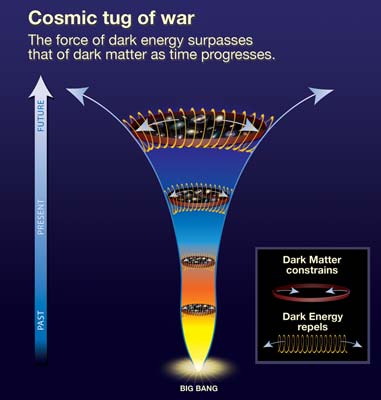
But to recap, dark energy is a postulated force that would explain some rather odd behavior of the universe. The oddity in question (for there are several oddities about our universe that require postulated things to explain them) is that the universe seems to be expanding at an ever increasing rate. Now that the universe is expanding is not at all odd. We've known about this since Edwin Hubble, a man brilliantly characterized as a "large mass of ego" by Bill Bryson, noticed that all the galaxies in the universe are expanding away from each other. Subsequently, a series of theories beginning with the "big bang" and moving on to modern inflationary cosmology have homed in on the idea of the universe originating at some sort of very small beginning (there are a few variations) and expanding outward from some sort of initial impulse (again, there are a few variations).

This is all fine and good and if you want some ideas about the how/why on that it won't surprise anyone that I now recommend Brian Greene's The Fabric of the Cosmos. But this expansion should be slowing -- as the shared gravitational attraction of all the, well, stuff in the universe gathers together and pulls on itself. And for a few billion years, it appears that it did. But then a few billion years ago, the rate of expansion began accelerating again. There is no good reason for this, not with the rule that we've been playing by.

dark_energy_diagram.jpg


It is as if, to invoke a classic Feynmanism, we were watching a chess game, thought we'd got the rules and moves pretty much figured out, and then someone castled. Uh-oh, what the hell was that?

Since then, cosmologists, astrophysicists, particle physicists, and plain old ordinary physicists have all gotten in on the bandwagon to try and explain why. The lure of being the first to explain a new (or dramatically revised) physical force is a pretty big one!

Alright, enough of that back-explanation. I said that actually trying to explain dark energy was beyond me. Oh, but it is different from dark matter. I know. They could have come up with some more varied names. Like "The Smuckers Effect" or perhaps "The Universal Choo-Choo." Either one might have been better.

So this dark energy stuff, whatever it is, is suddenly pushing the universe apart faster and faster. Or not so suddenly. Or it remains constant or decreases as a quadratic function while gravity decreases as a cubic function. Sorry. Got distracted again. The point is, we have no idea what this force, this dark energy, is. We can only observe what it does. And that makes it a wonderful place to study and understand the interplay between observation (experiment, if you like) and theory.

Science proceeds, in an idealized and perfect world, as a series of iterative steps. Someone observes a phenomena (say the increased rate of expansion of the universe). That person (and a few others) say "Damn, we didn't expect that!" Everyone then retires to their chalkboards and starts thinking of theories to explain what is causing this phenomena. The theories will span a broad range. Some might involve zero point energy, others extra dimensions, still others giant turtles. As the theorists theorize, the experimenters begin to contemplate the next round of experiment or observation (I think of experiment as an active act -- where we do something, such as at a particle collider -- while observation is a passive act where we take data on what the universe is already up to -- as with a telescope).

Theorists and experiments/observers are different. The former are the ones with the unkempt hair, the latter the ones with the dirty clothes and coffee addictions (particularly in astronomy).

Anyhow, while the theorists are using their imaginations and running the numbers, the experimenters/observers are doing their thing and building the next generation of machines. What proceeds then is something like a lottery. Or perhaps a reality TV show, though I doubt "Survivor: CERN" or "America's Next Top Scientists" or "Theorizing with the Stars" will take off anytime soon.

Any good theory brings a few ingredients to the table. It must offer an explanation for why the phenomenon under consideration occurs. It ideally should offer a mechanism to explain how it occurs. And it should provide some sort of mathematical formula that can fit the observed data to a high degree of accuracy. Lastly, that mathematical rigor should allow for some degree of prediction of as yet unobserved phenomena that can test the accuracy of the theory. This prediction might simply involve taking the measured predictions to a few orders of magnitude more precision. Or it might involve a wholly new physical manifestation. Either way, it provides some way of telling if the theory will have the winning number come lottery time -- the return of experimental results.

We go round and round like this. The results from each round of experiment feed the next round of theory. The predictions of a given round of theory guide the direction in which the experimenters/observers turn their searching. Rarely, however, are things so precisely beautiful as this, like turns in a board game. Usually, after a while, everything gets all out of synch and the experimental and theoretical processes get all overlapped.

But dark energy is new. It was accidental in a wonderful way, and the demands of further experiment have allowed for a long and fruitful phase of theoretical contemplation. And now the experimenalists are about to have their day. And by now I mean in about eight years, because that is how long it takes to get a space mission from budgetary contemplation to launch pad. And then a few more years of taking data.

Science is for the patient, these days.

This whole process of theory-experiment (or observation) is crucial to the scientific quest for understanding. It always galls me when people talk about how scientists don't actually know anything -- they just have a bunch of guesses. This points to a fundamental misunderstanding of what a theory is. It isn't a guess. If it was, there might be some credence to the idea of giant turtles playing a role in dark energy. Rather, a theory is an educated attempt to explain a phenomena. It is a look by a very experienced observer at a set of behaviors, an assessment of what those behaviors might mean, and an attempt to predict what they might mean for the future.

We all form theories all the time. When we spot a car swerving erratically while driving at 2am, we say "Woah, look how that dude is driving. I betcha' he's drunk. Look out, he might miss that turn..." We observed phenomena, offered an explanation, and attempted a prediction. The depth of prediction can be tricky. If we only say "This driver will keep swerving around" it may not eliminate other possibilities such as looking for something he dropped, having an epileptic seizure, or making out with the passenger. But it is entirely possible that a drunk will in fact make that next turn too. Or never intend to take it.

The scientific process is nothing different. It is not (and does not pretend to be) a fixed rulebook. It is an evolving set of understanding of the universe. Science is not a set series of answers as it is so often (and so wrongly) presented. Rather it is a process, a pursuit of those answers.

And so when more accurate measurements gave rise to results that disagreed with the predictions inspired by Hubble's results, the result was not joy and frustration, but excitement at the opportunity to solve a new puzzle. An Asimov quote that those who have read email coming from my work address will recognize summarizes this mood better than anything:

The most exciting phrase in science, the one that heralds new discoveries, is not "Eureka!" but "That's funny..."


And now the prospect of dark energy is out there, proposing a grand enough prize and an exciting enough pursuit that seemingly everyone is getting into the game. Established scientists, cranks, those hawking ideas from the fringe, conspiracy theorists, random posters on the Internet: each one has some idea, spun slightly to reflect individual specialities and biases, for what might be at work.

The observational guys have been at it just as enthusiastically, constantly devising new approaches to reflect the latest ideas of the theorists and the latest technological developments in measurement apparatus. Dark energy isn't something we can test in a laboratory with a dark-energy-ometer or create with a steel cased apparatus connected to several thick cables. It acts, by all accounts, over vast distances and only manifests to a measurable degree when other forces (namely gravity) are at their most feeble. And so an earth-bound measurement (even if we knew what to look for) seems doomed to be swamped by noise.

This results in observatories. For various reasons, these would be observatories best sited in space, at the L2 point about a billion miles from earth, where it is dark and cold and not much gets in the way. The idea would be to observe, with great precision, the distances and recessional velocities of several thousand (or million) objects in the middle distance of the universe, the distances over which dark energy starts to manifest -- out to about twenty billion light years (117,580,000,000,000,000,000,000 miles).

A few approaches have shown up. The first involved hunting for something called Type 1A supernovae. These moderately rare explosions function through a well understood mechanism that has the handy feature of producing a reliably predictable brightness. The result is something called a "standard candle" -- an object of known intrinsic brightness which allows the estimation of its distance by comparing that source brightness with the observed brightness. That's good -- and Type 1A's are how this whole dark energy thing got started -- but it turns out it is not good enough.

Clouds of gas and dust can get in the way and it always is possible that we don't understand the Type 1A quite as well as we thought we did. So more recent approaches to understanding dark energy have tried to invoke several different techniques of measurement. Acoustic Baryonic Oscillations (I'm still trying to figure out what those are, but they sound really interesting), weak lensing, and a few others have all surfaced. The result is that any dark energy space mission that actually gets flown will end up as a fantastic multi-disciplinary observatory, quite different from the specialist that was originally envisioned.

Picture 14.jpgThe glory of all of these approaches, and of all of the missions that seek to imlement them, is that they will conduct their work through massive "wide and deep" surveys. Taking vast numbers of long exposure images across a large area of the sky, in other words. This is the advantage of a dedicated mission -- Hubble or the James Webb could do the same science, but are general purpose instruments contended over by the entirity of the vast astronomic (and astrophysic) community. But a dedicated mission, running a pre-planned scheme of observation, can produce the staggering amount of data that is necessary for the statistical analysis upon which dark energy studies must be based.
But this vast survey, while intended to specifically test a signle scientific concept, will also have enormous implications for the rest of the community. Currently, we stare through straws, looking across the vast night sky to find things that are interesting. Sometims we do so by chance, but more often we do so by looking at areas that we've already identified as interesting. The terabytes of data coming back from SNAP, DESTINY, ADEPT, JDEM, SPACE, Euclid, or whatever mission or missions end up flying will end up producing an astronomic and astrophysic legacy ready for the picking. A generation or more of astronomers and astrophysicists will mine this legacy to confirm and clarify their theories and hypotheses. And, here and there, they might discover something completely new, something entirely unexpected, something funny, and start the whole glorious process over again.

Wednesday, September 10, 2008

My Friends (in space)

So feel free to hum "My Friends" from Sweeny Todd if you like, but this has nothing to do with homicidally vindictive barbers or straight razors. It is actually a little look at one of my favorite things (if you go over to the right hand section of the blog you'll notice things like favorite calculators and favorite elements and, yes, a favorite space probe).

Today is New Horizon's day in the sun. Which is good, because out beyond Saturn there is less and less Sun to go around. Today we focus on a biography and an explanation of this one little project and its journey to flight and why, exactly, I choose it above and beyond all other comers for the title of "favorite space probe."

I don't want to start by drowning this whole blog in a sea of specifications and technical data -- if you really care about how many milliradians the ifov of the LORRI imager is, look it up. Rather I'd like to start by recounting a rejected name from the day's of New Horizon's development. Apparently naming the damn thing was proving quite a challenge. As I've heard it told, it was almost a case of analysis paralysis, and some interesting candidates were circulating around, mostly tongue-in-cheek. One that actually made a big impression on me was FARR: Finally A Return to Reconnaissance.

Ok, no space probe is ever going to have a name beginning with "Finally" and the crankiness it implies. But there is a message in that name -- for decades we've been going back to revisit worlds already explored to gather more data. Missions have grown more focused on particular themes ("Follow the Water!") or areas of understanding. The approach reminds me a bit of what Hollywood has been doing of late -- remakes, sequels, and adaptations. Don't take the risk (the studios and executive producers seem to think) of going into completely new territory because you might gaffe it entirely and end up with an expensive flop. Instead, pick a relatively well known subject with a somewhat predictable audience and go for that.

There's some legitimacy. I'll go see Ocean's 14 or whatever they are up to now. At least I'll rent the video. My daughter will definitely go see Shreck the 4th. But you know, that first Matrix movie could have been one hell of a flop. And with film budgets what they are now, that thinking is going to force a real drive to conservatism. Plan (1) says you could make $200 million or loose $100 million. Plan (2) says you are almost guaranteed to make $150 million. Bottom line choices make that easy. Balls-out risk takers are rare, now a days.

Spaceflight's gotten the same way, to an extent. We're revisiting worlds we know. We're looking at the details, following exploratory themes. This is great science, and a lot is learned from it. There is, I think, some extra conservatism even within this overall trend to avoid looking directly at the big issues (exobiology is what I'm talking about here) because as long as the big questions are unanswered there is still a chance of flying more missions and learnign plenty about the interesting but undramatic other stuff.

Don't get me wrong. I love this thorough understanding of our neighborhood. I'm more of a deep-space astrophysics guy myself, but Titan, comets, Venus, Mars, Jupiter, Io, all of 'em are fascinating places. And I'm certinly not a fan of the overly-cowboy manned spaceflight program promoted under the Bush administration. But that's another issue.

I was raised, however, on the pioneering flights of the Pioneers and Voyagers. I remember staying up until unusual (for a nine year old) hours to watch episodes of Nova or other specials on PBS (channel six!) as the probes encountered Jupiter, Saturn, Uranus, and finally Neptune. I remember that feeling of seeing new worlds and new moons for the first time. The Saturnian system (apparently it is technically accurate to call it Kronian but unnecessarily arrogant to do so) was the most vivid memory, because it really was a special event for a precocious 9 year old with a space infatuation. The rings, beautiful and so much more complex than ever imagined, moons, moons, and more moons, from shrouded and active Titan to icy

The robotic engineers at the Jet Propulsion Laboratory were my idols, and the planetary scientists gathering and interpreting the results that these probes brought back filled my imagination the way the tales of Lewis and Clark filled the imagination of boys generations ago. But with that one titanic act of exploration, that once in a zillion chance alignment of the great gas giant and ice giant planets, it was done. We'd been everywhere. It was like the scene in The Truman Show where young Truman tells his class he wants to be an explorer and the teacher quashes his dreams by pulling down a world map and saying (I paraphrase) "It's all been explored!"

From this point on, Lewis and Clark could rest at home, take it easy. Follow-on explorers would set about to filling in the details, trading with the natives, exploiting whatever resources they could find, and finally building shopping malls. No wonder Lewis killed himself in the end.

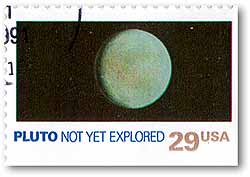
pluto_stamp_03.jpg
But then along comes the chance to go out and explore a new world. One so distant, so remote, and superficially so boring that it had never really been considered for exploration. The gung-ho "faster better cheaper" 1990's begat a few sketches, edge-of-the-envelope designs that pulled out all the stops in an effort to get an ultra-lightweight spacecraft out on a flyby trajectory. PFF, the Pluto Fast Flyby was a poster child for (yet another set of) plans to develop a common set of instruments and back end technologies to facilitate missions to all sorts of cool and exotic places -- Europa, Comets, Neptune, you name it.

None flew.

Through the fast moving space policy shifts of Reagan-Bush-Clinton-Bush (and a couple of dramatic economic cycles thrown in for the bargain), Pluto missions were on and off and on again in a half dozen different variations. International missions launched by Russian Proton boosters...ultralight weight "twin" missions launched by Titan IV boosters to catch both sides of the planet...and then death. Complete and total demise of the whole Pluto mission thing.

In the meantime the planet itself kept getting more interesting. It had an atmosphere. It had a moon. It might have meteorologic or prebiotic processes. We mapped some of its surface features (crudely). Suddenly this pinpoint of light in the distance was a solid world with features of, well, a real planet.

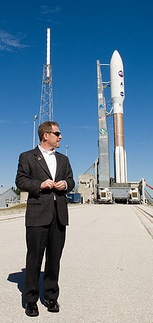
Soon the letters started coming in. Alan Stern, long time Plutophile (read his book!) and a few earnest space enthusiasts kept the dream alive and via the newest tool for space science outreach organized an Internet campaign to revive a Pluto mission. It worked. Congressional fiat inserted (and mandated) funding for a competitively selected Pluto mission. The folks at the Johns Hopkins Applied Physics Lab put forward a proposal -- headed by Stern. JPL put forward a proposal of their own, but I suspect it was mostly just to keep the APL honest. This was Stern's baby, and everyone knew it.

He finally settled on a name -- New Horizons -- and so the mockingly appropriate FARR was retired to the mists of history and blogging. New Horizons works -- I grant them that -- and is a proper name and not just an acronym. But I miss something of the spirit of FARR.

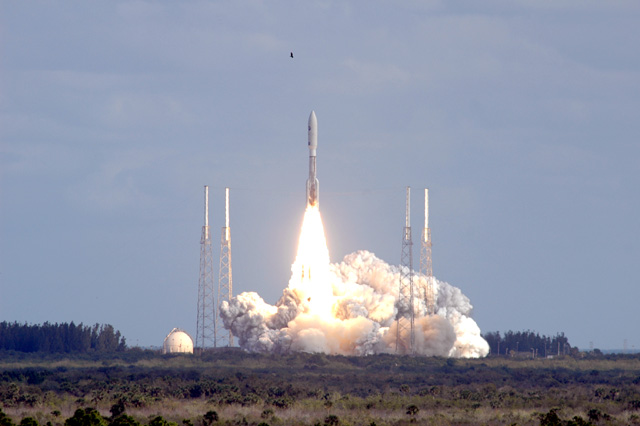
It took a few years -- and a few near fatal setbacks -- to get the thing on the way. A security scare shut down processing of the Plutonium fuel pellets necessary to keep NH warm and powered. Scrambling managed to get enough Plutonium together to ensure a successful mission. Anti-nuke protesters made desultory threats at preventing the launch -- but other than a few ill-informed crazies and a pacifist grandmother or two, the public failed to mobilize to their cause. The Boeing strike season meant that the workers who would have prepared the 3rd stage motor were walking the picket lines so salaried managers pitched in to ready the motor -- and the protests of the strikers went generally unheard except by the anti-nuke crazies. Winds delayed the first launch attempt. A freakish power outage prevented day two. And clouds almost shut down day three -- until luck and a hole in the weather resulted in one of the most spectacular unmanned launches I've ever seen.

Aviation Week's wonderful article tells the details of the complexity of supporting this little spacecraft's journey. I find the final part of the article -- the throttling profile of the RD-180 first stage engine -- to be particularly telling. Most flights bang the throttle to the stops until the very end when you might start to go easy to avoid pulling parts off. But this flight pushed the profile optimization for every meter per second of delta-V it could generate.

Roll back to my Why'd We Put the Rockets There post for a video of the NH launch in all of its glory. More thrust than any other current US launcher save the Shuttle. Off the pad like a bat out of hell and from then on, no looking back.

New_Horizons_Launch_11.jpg


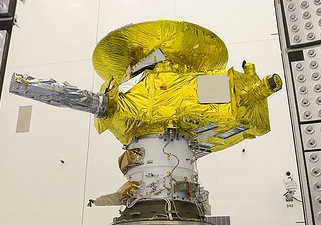
I'll save the "gee whiz" statistics and detailed instrument descriptions for the team's fantastic web presence. In a nutshell the probe is a piano attached to a satellite dish -- a compact body designed to keep heat in and minimize mass attached to the largest dish antenna cheaply available. The radioisotope generator (home of the pesky Plutonium) sticks off to one side to keep its temperature manageable. Gold foil provides much needed insulation so that the waste heat from the electronics and the RTG can keep the vital systems warm, including preventing the propulsion systems propellent from freezing.

The science instruments are like the eyes of a lemur, oversize and blinded by daylight, carefully tuned instead to the dark distance of Pluto. A telephoto camera, a multicolor camera, and infrared and ultraviolet spectrometers comprise the primary remote sensing suite. Three instruments record the nature and intensity of dust and heavy and light charged particles as the craft drifts by Jupiter, through deep space and, later, through the Pluto system. Finally the onboard radios play a part by enabling careful trajectory tracking that reveals in detail the mass of objects in the Pluto system and by a clever bit of passive microwave radiometry that helps determine surface temperature.

Picture 2.jpg
The engineering inside the little thermos box of New Horizons is capable of greater autonomy and endurance than any spacecraft before. Indeed it must be -- for the decade long journey would tax the budget and patience of ground crews if controlled in a traditional manner. Electronic and mechanical components would also wear out sooner, so the NH team devised a scheme of "hibernation" where the probe spends the majority of the inflight time with the majority of systems powered down, emitting a low power beacon tone to either reassure controllers that everything is ok or to alert them that there is a problem -- and the need for an intervention.

Picture 1.jpg
Back on Earth, Stern's team has run a model of outlook. Perhaps spurred by the grassroots campaign that helped win the mission its day on the launch pad, they have kept their eye on those of us who follow spaceflight with passion and interest. Pluto's very enigma and extremism helps -- everyone likes a mystery. Members of the team -- right up to Dr. Stern himself -- have made frequent appearances on space news boards like my favorite UMSF. In one of the most phenomenal acts of public outreach ever, the team actually accepted the contributions of Internet supporters to the science program.

Approaching their encounter with Jupiter, the official science team was busy doing official science -- planning the aspects of the Jupiter swingby that would generate the most compelling scientific data return. Several enthusiasts on the UMSF boards, however, used trajectory information provided by the NH team to simulate in great detail the probe's journey through the complex Jovian system. Using these simulations, they were able to identify a number of "Kodak Moments" as space probe types call them -- the beauty shots of crescent moons, ring systems, and extraterrestrial volcanic eruptions that actually make it in to the newspaper.

Since the science team actually had more spacecraft resources than they had time to plan for, they accepted these amateur contributions and, instead of sneering at the part-timers, added the suggestions in to the flyby mission plan. And you can bet which images appeared on the newspaper covers -- not the dull-but-scientific ones, but the glamour shots that those of us out on the Internet came up with.

The New Horizons team has also done all the standard things -- a CD carrying names of supporters who registered on the Internet is mounted on the probe (and you can bet that my name -- and the names of those closest to me -- are on there). Podcasts, email updates, and well maintained websites too. And some of the most easily available detailed documentation of a current vehicle I've ever found. They've got the now obligatory Twitter presence (NewHorizons2015, if you want to get the updates) which is pretty chatty right now since the team is working one of the annual checkout periods that will lie between long sessions of hibernation.

For these efforts and others, Stern's gone on to become something of a hero (and very occasional email correspondent) of mine, not least for his brief stint as head of NASA's space science division -- a stint that was oddly parallel to my own stint with my most recent employer in timing and apparent motivations for departure. But now he's back at the APL, flying space probes when he can and getting instruments of his aboard nearly a half dozen other flights. NH is the largest ever PI (Primary Investigator -- as opposed to a NASA laboratory) managed space project NASA's ever flown -- you libertarians can think of PI managed missions as sort of like the charter schools of space exploration. Through blunt perseverance, clever engineering, shrewd campaigning, and tight management, it is bringing a little bit of the mystery back in to space exploration.

And out there, a billion kilometers away and just beyond the orbit of Saturn, finally flies the return to reconnaissance.

By the way, if you want to see some absolutely spectacular photography of not just the New Horizons launch, but several others as well, check out launchphotography.com.

Friday, September 5, 2008

Why'd We Put the Rockets There?

It happens every Atlantic hurricane season: news reports on all of the popular spaceflight websites about how Hurricane So-and-So delayed the rollout of the Space Shuttle or damaged this rocket on the pad or that important piece of ground equipment. And every year, right around the Atlantic hurricane season, I find myself facing the question: why did the United States put its space launch facilities right in the path of the typical storm track? So every year, just to remind myself that it wasn't a completely ludicrous decision, I go through the physics of the thing.

And physics is exactly why the United States sited its primary national launch site on the south coast of Florida. It wasn't that the land was cheap or that a Floridian senator was on the committee or such (these things may or may not have been true, but even if so, they were not the overriding reason).

One of the reasons for the birth of the Space Coast down there in Florida is safety. Launching rockets was, and indeed remains, a tricky business. The occasionally go...wrong. Even successful flights shed parts (sometines unintentionally but more often intentionally as spent stages and fairings are jettisoned) And for that reason, it is nice to have a large chunk of empty land that your launches can fly over. And, for reasons that we will shortly discuss, most space launches fly to the East, more or less. That would confine a United States launch facility to the East Coast. Conceivably Hawaii could be used as well, since by the time a vehicle launched from that location reaches any significant land mass, it will be flying high enough as to pose no threat. But flying from Hawaii would raise infrastructure and transportation challenges, particularly in the 1950's when the Space Coast was first evolving. One could argue that the wastes of far northern Canada would be safe to fly over and that Alaska would make a reasonable launch facility -- but in addition to the dangerous politics of arguing that anyone's land mass is insignificant there are some good reasons why far Northern launch sites are not the best to pick.

And so now we enter the physics discussion. Before we can go too far, let's pause and think about what a vehicle in orbit is doing. It is going around the Earth at a rate just fast enough to offset gravity's attraction. Objects in orbit are still attracted by the Earth's gravity. It is an easy misconception to imagine that they are some how "beyond" the force of G, but achieving that feat requires a great deal more distance (theoretically an infinite one) and a great deal more velocity. It is just that their motion is such that as gravity relentlessly tries to pull them down to the surface, their own motion offsets the tug -- just like when you whirl a bucket of water, the water's own momentum (as manifested in that handy engineer's shortcut of centrifugal force) holds it in place. In orbit, your whirling velocity around the planet wants to push you off into deep space -- but the attractive force of the massive planet holds you neatly balanced. It is a beautiful thing, really.

The operative point, in case you don't want to spend too much time on the bucket-is-like-a-satellite analogy, is that putting something in space really is all about getting it to go sideways. Not up. Next time you have occasion to watch a space launch on TV (or in person, if you are so lucky) notice the trajectory. It can be a bit hard to follow since the camera guys always zoom way in, but the Shuttle (or whatever) does not go straight up. After just a few seconds, the vehicle begins to pitch over and fly ever more horizontally.

There is a bit of subtlety in the details of the trajectory design, degree of lofting, etc. But the key issue is that a rocket rises a little bit but goes sideways a lot. The first segment of flight is a gradual transition from the vertical (handy for setting things up) where you are climbing out of the irritatingly thick atmosphere to a horizontal motion where you are building up the speed necessary to get your bucket whirling fast enough to offset the planet's gravitational attraction.


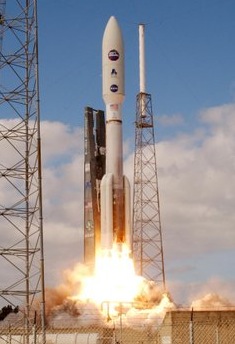
Watch this video of the New Horizons launch and notice how the big Atlas V appears to be pitching over to an increasingly horizontal trajectory. It is hard to notice second-to-second, but over the course of a minute of flight it becomes pretty apparent. For a real dramatic illustration, watch for the jettison of the solid rocket boosters just about 2:20 into the video. Then at about 2:36 the rocket executes a very dramatic pitch-down maneuver to bring the direction of its flight increasingly horizontal. Apparently this pitch down was even more noticeable to observers watching the launch in person -- enough so that it caused some moments of real worry for those who did not know to expect it!

As a rule of thumb, it takes a velocity of around 7,800 meters per second (I'm going Metric on you for this one!) relative to the Earth to get something in the lowest possible sustainable orbit (any lower and you will start bumping into enough of the molecules of ethereal atmosphere at that altitude that you'll slow down...and once you start slowing down you hit more atmosphere...slow down more...and the result is obvious). That's awfully fast, and one of the reasons it takes such gargantuan rockets to loft even small payloads is that building up that much velocity takes a lot of energy. As a brief footnote, I'll mention that with practical considerations taken into place, it takes 9,300 to 9,800 m/s of velocity to actually make it to LEO -- the extra is accounted for by aerodynamic drag (100-200 m/s), control and steering losses (200-250m/s), and the losses spent overcoming gravity (the rest).

In such a situation, engineers will try to take advantage of any asset they can. Rockets are built light, fueled with the most desperately energetic propellants possible (and historically some very, very exotic and toxic combinations have been experimented with), and shed unneeded mass at any chance possible. They are also almost always launched to the East. Why? Because the Earth turns.

Picture a sunrise: in the East. A sunset? In the West. Our planet, in addition to a whole complex series of motions relative to various other bodies in nearby space, rotates around its own axis, turning from West to East at a rate such that it completes one full rotation in 24 hours. At the equator, on the surface, that works out to a speed of about 465 meters per second (just about 1,000 mph). Why don't we feel this? Because everything else around us (air, water, train tracks, laptop computers, coffee cups) shares this motion. Actually, there is an important subtlety at work here: at the poles, we have zero velocity due to rotation, we'd just turn in place. Spin a globe. The equator is blurry fast, the middle latitudes (North or South) move at a moderate pace, and the poles barely seem to move at all. The velocity, at a given latitude, is proportional to the distance around the globe at that latitude. Amongst other things, this causes the swirling interactions of atmosphere responsible for no small part of the global weather patterns.

It also provides a powerful incentive for launching rockets to the East, near the Equator. The Earth gives you a boost equal to the rotation-induced velocity of the surface at the latitude of your launch site. At the equator, that amounts to 465 meters per second. At Kennedy Space center, about 28 degrees latitude (of 28/90ths of the way from the equator to the North Pole) this boost is still 450 meters per second. But were I to build a launch pad here in Seattle, at 49 degrees latitude, the boost is only 305 meters per second. If you are curious, the degree of kick varies with the cosine of the latitude.

Given the skin-of-your-teeth challenge of getting something into orbit at all, it is not remarkable that engineers have sought to site launch facilities to take maximum advantage of this simple bit of physics. Now a word of warning -- and clarification for any real rocket scientists who stumble across this: I am ignoring polar orbits, sun-synchronus orbits, non-due-east launches, and the complexities of plane change maneuvers. I know.

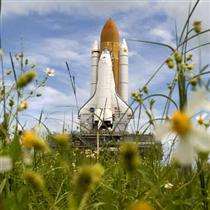
atlantisready.jpgLaunching from Kennedy, at 28 degrees North, provides a boost of 450 meters per second -- about 5% of our total rule-of-thumb velocity increment. For a hypothetical rocket I've been doodling out in the form of a Numbers spreadsheet, this works out to a payload (to low Earth orbit) launching from KSC allows the payload to increase from 7000kg (for a mythical zero-velocity launch site) to 8500kg! This happens for no increased launch vehicle mass, no increased cost, just a willingness to put up with a few hurricanes.
I know that I have a good time ripping NASA a new one in this blog (except Alan Stern, and he's no longer with NASA). But this is one area in which I have to say they chose well. Kennedy is effectively the southernmost point in the continental US that has a clear space to the east. It is interesting, however, to look at some other launch facilities in light of this information and to try and understand the rational behind their selection.

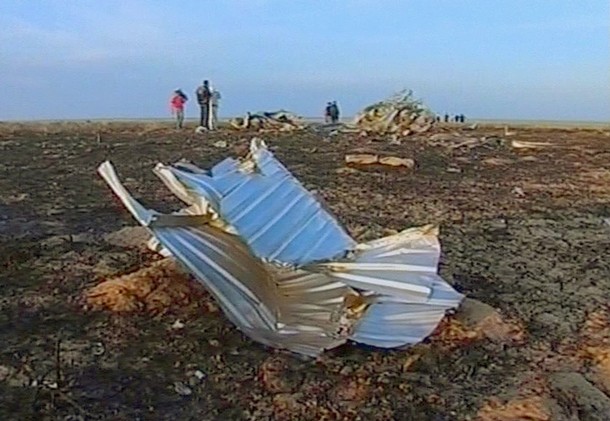
610x.jpgFor starters, look at Russia. Devoid of a "space safe" site to the East (almost any Russian East coast launch site would have to fly over Japan), they are forced to launch from the West side of the nation, taking advantage of the vast reaches of emptiness that fill the middle part of Russia. This approach isn't without very serious drawbacks -- spent 1st stages from Russian Proton launchers litter the steppes of Kazakhstan. The toxic traces of the NTO/UDMH propellant that Proton uses have begun leaching into the groundwater supplies with, well, predictable results.
Their other launch facilities are all in the far (for a launch site) North and get even less help from the Earth than my mythical Spaceport Seattle. To make matters worse, even when launching Zenit or Soyuz boosters (which generally avoid the toxic-waste-dump problem of Proton) decent range safety practice dictates narrow and oddly positioned corridors through which launches can fly -- dramatically restringing the orbital options available to Russian flight planners.

Other launch sites face some even more interesting challenges. Japanese launches often must contend with the fishing season. Plentiful fishing grounds to the East of the launch sites mean that, in an island nation that eats a lot of seafood, space launches must wait until the fishing boats get out of the way rather than imposing an exclusion zone is is done off Florida.

Israel faces perhaps the most challenging geographical launch constraints of anyone. Located around 31 degrees North latitude, things wouldn't seem too bad (not as good as Florida, better than Russia) until the political climate of the region is taken into account. Raining debries from a launch (successful or failed!) down on hostile neighbors to the east poses a grave political risk, and a potential security challenge should any piece fall into the hands of hostile intelligence agencies. There is also the risk of a launch, even announced, over hostile territory being seen as an aggressive act.

What all of this means is that, alone among the space capable states, Israel must launch her satellites DUE EAST -- exactly the wrong direction. Not only do Israili launch vehicles get no assist from the Earth's rotation, but they must actually work to overcome it first! The result is a penalty of about 450 m/s beyond the basic 7,800 m/s required for LEO insertion. Another amusing effect are the unique orbits occupied by satellites launched in this manner.

The European Space Agency launches from French Guiana -- from a point only 310 miles north of the equator. This supplies something like 463 m/s of velocity increment. Compared to the launch site in Plesetsk, a Russian Soyuz rocket launched from the ESA spaceport picks up 1200kg of payload to a geostationary transfer orbit. That is an increase of 80% -- though in all fairness the launch azimuths of Plesetsk are particularly poorly suited to this trajectory and the difference for other orbits range down to only 20% -- but still significant!

Similarly close to the equator is the very clever Sea Launch platform and rocket. This is essentially a Russian Zenit rocket mounted on a converted oil platform that migrates down to sit right on the equator for launch. The result is the full 465 meters per second of possible rotational kick -- and freedom to launch on whatever azimuth or pathway is wanted!

So hurricanes are not, I suppose, such a bad price to pay.

Monday, August 18, 2008

The Little Man

So I've been reading, finally, about something called Direct 2.0.

It is not a piece of software. Rather, it is an attempt to re-architect (yes, that is a valid use of the word "architect." I know, even a linguistic curmudgeon like me will accept the verbing of nouns in an appropriately aerospace context) the deeply flawed plan to return people to the moon that NASA has drawn up in the past few years. It was begat by some guys I hang out in newsgroups with. Newsgroups, you know, those internet communities that I usually rail against ("Its all been downhill since AOL gave the hoi polloi access..."). But this one is something special -- nasaspaceflight.com. Together with virtual sister site unmannedspaceflight.com these two are the places I hang out when I want to hear real spaceflight professionals argue and/or get the inside scoop/speculation on what is going on Out There...

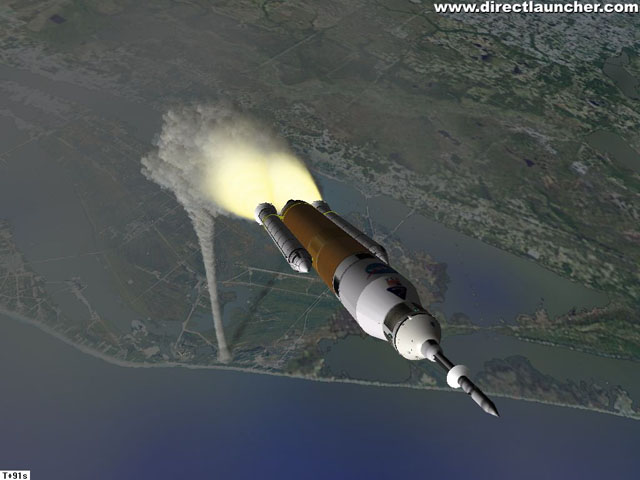
DIRECT_CLV_T+091.jpgDirect 2.0 is an interesting plan to take the same basic ground rules that the Constellation office bungled into the Orion capsule and the Aries booster family: re-use hardware, be fast, be cheap, be safe, be political. For some reason, they appear to make work what ATK and the guys at JSC have turned into one of the most profound cases of "throwing good money after bad" that I've seen since Pets.com collapsed. Now granted, when it first showed up on ATK's website, the Aries idea, the stick and the...well...whatever the other thing is called...seemed like potentially elegant approaches to getting people into space. And since the my, oh my, what a pattern of unrelenting growth and going-to-hell-ness. For the big boy, four engines...then five...now six...and ever more segments into the solid rocket motors. For the stick first rampant weight growth, then the oddly Mercury/Redstone like non-sustainable orbit that requires a service module boost almost immediately after separation, and now the crisis of ensuring that the astronauts are not jiggled into jelly by some sort of multi-million dollar paintshaker. Solve by...what...putting the parachutes on springs so they damp out the oscillations? OK, I'm perfectly comfortable with the theory and accept that the paradamper is a better idea that the absurd notion of the highly scarfed OMS engines firing in time to damp the oscillations, but this sort of solution is what I'm using to prevent my washing machine from shaking the house when it hits a spin cycle.

I'd like a little more robust planning going into my rockets, thank you very much!

And all of this -- weight growth. And no margins to begin with, so the moment Orion swelled at all...well...the rest is well documented in the PowerPoints you can download from nasaspaceflight.com. I'll leave it at that.

So some guys on the board got together and tossed out some ideas and did two things: they re-architected the overall plan and then they developed a new vehicle (singular) to support it. The result is, generally, a whole lot more elegant and efficient and cost effective. I'll be cynical enough to say "it'll suffer the same growth and problems as Aries did as it transitioned from ATK paper study to possible flight hardware." And I believe it will -- but the crucial difference is that the guys behind Direct 2.0 actually have enough margin to accommodate the unexpected without the whole thing turning brittle and shattering into a million thrust-oscination-induced pieces.

Direct 2.0 (and I'm intentionally avoiding a long, technical discussion of the designs and their merits) also has the look-and-feel of something well conceived and well planned. It does not have the square-peg-round-hole feel that the Aries rockets do. It smacks of actual synergy in the design.

Now here's the crux of the thing: it doesn't take a genius to see that there are some deep flaws in NASA's current plans. But government agencies are notorious for not wanting to admit that they Had A Bad Idea and then needing to go back and rework things. But we are about to have a presidential election. And those inflection points can be useful. Either of the two incoming presidents has the positioning that they could mandate a re-examination (and in the background mandate the change) of NASA's space exploration architecture. McCain's the rebel (after a career in the Navy?), Obama's the change guy. Either one can pull off a dramatic shift in space strategy (either one is likely to do so, actually, though not necessarily at the level I am advocating) while staying true to image and policy statements. In reality, Direct 2.0 wouldn't really change the suppliers at all, its just a loss of face at NASA.

So whomever you end up being, Mr. President, take advantage of the demise of the Bush regime and among the changes you make in the direction of American space exploration (many of which, whomever you end up being, I fear I will not like). Pick a decent, robust, well planned approach to getting people into space. Even if the whole Moon thing falls apart (as it probably will) or the Mars thing falls apart (as it almost assuredly will), we'll end up with a decent, supportable way to put Things And People Into Space. And I wouldn't like to lose that capability, subcontracting it to other nations and entirely sacrificing an enormous (and hard to recover) body of institutional knowledge.

Regarding institutionalized knowledge -- just look at SpaceX. They can read the same textbooks and technical papers as the guys at Lockheed Martin and end up 0-for-3. That's experience, judgement, and culture talking. That's what you loose when you stop building something for too long.

orion_landing_system.jpgBut above the practical NASA-like issues here, there is a phenomenal message that an official endorsement of Direct 2.0 would send. It would signify, perhaps more than anything, the Coming Of The Internet. The flattening of the world that has been written about so often would splash down in the waters of the American space program. Already us out there on the Internet have helped out those who will listen, starting with the incomparable Alan Stern and his New Horizons team who gratefully accepted the suggestions of several fans as to how to construct the Kodak Moment shots as their little probe sped through the Jovian system.
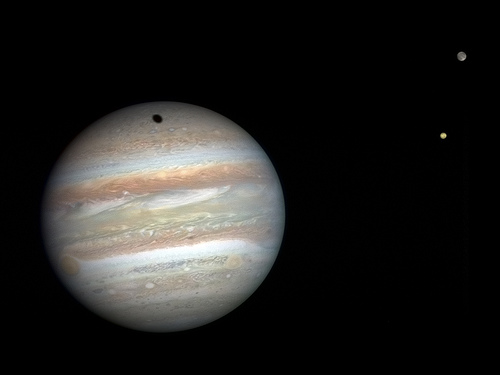
2216891305_e71caf2ab7.jpgThe science team was understandable busy focusing on the real scientific observations. Knowing this, they listened when folks at home punched the probe's trajectory data into computer simulators and came up with the times and pointing angles necessary to get the spectacular shots of Jupiter and its moons that made the front pages. The tools are no longer beyond the reach of the ordinary, interested, outsider. The interest has always been there. If you will let us in, you'll find that we are not just a nuisance but a powerful, useful force. Welcome us.

New Horizons gave us the tools we needed, we offered suggestions, they listened. The result was synergy -- very happy amateurs (all any of us on that board want to do is to get to do what Alan and his team do!). Great PR photos -- and great PR about the outreach and inclusion.

What kind of an upset would it make, what kind of an "Only In America" free-enterprise message would it send if a few folks using freely available data and commercially available software designed the method that this nation uses to get into space?

Friday, August 8, 2008

A SpaceX debrief (or, Hubris vs. Conviction)

Leadership is a good thing. And good leadership requires conviction. But conviction must be moderated by humility and thought.

Picture 1.jpgThis is all about rockets. Exploding rockets, to be precise. Rockets that collide with themselves and then proceed to fall apart, to be progressively more precise. Rockets that do so because of design errors that people on Internet chat sites are able to spot before the engineers who designed the rocket are. Granted, these are chat sites populated by rocket engineering professionals, but still!
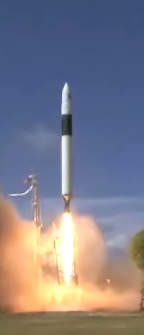
The reactions form SpaceX and charismatic founder Elon Munsk were predictably glib. The problem was identified, verified, and easily corrected. If they had a rocket ready to go, they'd shoot it after tweaking a bit of software. Reliability has always been priority one, they have a better way of doing things, and everything will work out just fine. I like the idea of SpaceX. I like the idea of a dot-com punk showing up the established players. I like the idea of cheap, reliable access to space. I like that there have been a few glimmers of admission that this whole rockets-into-space business is harder than they expected.

But I don't like that every time we hear a new release, it is a reset back to the same old eager confidence, the Russel Crowe dialog (apparently South Africans and Australians swear with the same alacrity), the cheerful admission that wow we learned some lessons but now it is just an easy fix and everything will go great. It is always an easy fix -- it has been an easy fix for three unsuccessful launches and a host of less dramatic problems and failures.

To assert that a series of avoidable design errors is nothing more than a series of design errors -- bad luck or inexperience in effect -- is to ignore the fact that these errors could (and many would say should) have been caught at the outset. SpaceX is reinventing the wheel. Which means that there are a large number of photographs and public domain documents about wheel invention and construction out there. There are wheel engineers that you can hire away from folks who have been building wheels "the old way" for years.

But Elon chose to go it his own way, convinced that he had a better approach and that the paradigm could be changed. PayPal had, after all, been part of that great paradigm changing revolution: Ebay, Amazon, latecomers like iTunes and Wikipedia. I was there too, and I remember the culture (I'm banking that PayPal wasn't too divergent from Amazon). It took a certain degree of brass-balled self confidence to do what (1) no-one had ever done before (2) many were telling you couldn't be done (3) everyone else was trying to do before you could (4) was going to cost more money than you had (5) had the potential to be second-guessed by everyone. Bezos had the balls and the business plan (and, I might add, the personality to serve as our Charismatic Leader through a lot of tough and doubtful times -- an experience that played into more than a little of my president-as-personality theory as talked about in The Obama Post). Elon did for two successful business.

But physics is a harsh mistress. It won't reload a buggy web page, it can't be bought off with a refund and gift certificate, it doesn't stick with you just because you are better than the alternatives. If physics says you are wrong, your couplings corrode, your tanks buckle, your motors burn under thrust, your helium tanks underfill (more about that later), your GN&C algorithms don't converge, your stages collide, and your rockets fail.

Back in the day, when we launched, we pushed a key on a keyboard (footnote and company history moment: often this was actually done by the paw of an adorable pet Corgi) that flipped some symlinks and pow, the new feature/product/store was launched. Later, when it turned out that every single customer was told that John Grisham's The Street Lawyer was the absolutely perfect match for their buying habits, we realized what the testing flaw was, tweaked a few constants, and rolled out an update.

It was a software problem and we fixed it in software. We thought, almost every time, that the software was as perfect as we could make it. Whether we admitted it or not, there were going to be bugs when the launch occurred. There always were. But we knew, at a visceral level, that we could fix them through a quick roll back (more than once), raw human effort (most of the time), or a quick fix (pretty damn often). We always thought that we'd done enough testing. But knew that it wouldn't be enough.

Picture 2.jpgYou can't upload software to a rocket in flight and correct the mixture ratio of your main engine. Not in the 2:55 long first stage burn. You have to get it right, straight away. But the software mindset knows that you can debug. You have to debug. You code and test and code and test and launch and code and test and code and relaunch. The rocket mindset codes and tests and codes and tests and codes and tests...again and again and again and again. True mission critical software design involves parallel development teams (working in isolation to prevent communication and the formation of similar assumptions). True mission critical design involves multiple layers of check and recheck. Recheck checkers check the recheckers.
It is against the whole concept of a lot of "new business" models. It smacks far too much of the old Detroit assembly line where mechanic one didn't bother doing his job well because he knew that mechanic two, three, and four would catch and fix his laziness and that if they didn't checker one, two, or three would. And I do have complete contempt for this process -- when it has led to that kind of institutional diffusion of responsibility that means that neither mechanic 1, 2, 3, or 4 or checker 1, 2, or 3 are doing their job.

But when mechanics 1 and 2 cross check each other, shoot a digital snap of their work, and then submit it to checker 1 for sign off, that can be a healthy process. The mere presence of process does not mean unhealthy (overly rigorous, tedious, and stifling) process.

SpaceX is stuck with this "software mindset" of both assuming easy fixability and relying on sloppy planning and rushed decision making. Now all you coders out there, don't go thinking that I believe all software is tossed together willy-nilly with poor planning and launched with an expectation of fixing it in a service pack. No, only Microsoft software is. ;)

In reality, software projects can be well planned, well run, and produce excellent results with little trial-and-error debugging and tight schedules. It takes, however, very well thought out and carefully followed methodologies to ensure this. And it takes a team, from the top down, that buys in to the methodology in use.

Most of the aggressive software design methedologies (or system design, if you care to generalize) are designed to actually restrain the pace of development. Take your pick: scrum (my favorite), agile, RAD, TDD. All are essentially about providing a methodology that ensures or promotes a controlled, managed, organized cycle of communication, test, and development. The very idea is to prevent cowboy coding, to ensure that specifications are rigerously followed, communication channels are clear, and checkpoints observed.

I fear that enthusiasm, "there is a better way" self-conviction, and frankly arrogance (at least on Elon's part) got in the way of this process. Elon enjoys insisting that problems have been design problems and not cultural (and therefore systemic) problems. But he forgets (or hopes we won't realize) that designs are not born in isolation. The are born of a collection of people operating within a given culture. Now I don't want to sound all postmodernist here, but it is possible to examine the product of a design effort and gain an understanding of the culture that produced it.

Now I don't want to say that aggressive and independantly minded design schools are, by nature, out of question in the aerospace arena. By contrast, quite the opposite. Just look at Lockheed's Skunk Works, easily the most storied aeronautical design organization of all time. They were a small group, working on in many cases cutting edge processes, utilizing streamlined design, management, and accounting protocols. This does not mean they were sloppy. This does not mean they were careless. This does not mean they did not verify their work. On the contrary, the awarness of their responsibility (and knowledge that a company test pilot would be flying the thing) permeated the mind of every engineer. Speed, security, and economy are not at odds with rigerous procedure and quality design.

Today this attitude seems to be harder to locate. Some work in the happy playpen of a Google environment, toiling at aggressive projects for impossible hours but rewarded with perposterous perks including absurd amounts of personal and professional flexibility and freedom. Others toil in the rigor of Traditional Business, at a Boeing, reporting as scheduled, performing their duties as ordered, creating when called upon, and then freed to commute home with everyone else slagged in at the Boeing Access Road. But the two are entirely compatible. An elite group (like Elon thinks he has) working in isolation could do it but must be willing to:

(1) Embrace total, personal responsibility for individual and group actions
(2) Communicate and document regularly and clearly
(3) Establish minimum standards for documentation and then follow them rigorously
(4) Establish minimum standards for quality assurance and then follow them rigerously
(5) Admit areas of ignorance and weakness, calling for and accepting support when necessary
(6) Develop and adhere to procedures that ensure quality and safety of all mission critical steps of conceptualization, planning, design, test, and implementation
(6) Adopt in both hearts and minds philosophies and procedures that will ensure all of the above

Picture 3.jpgA very telling moment that I know well is the pre-launch instructions that show up just before the release from final hold at, I believe, T-6:00 during an Atlas V countdown. The Atlas V is one of the most well engineered and well processed of "old school" boosters. Their countdowns are always flawless and their nearly always so (they had a one-time hiccup with a bad valve in an engine that resulted in off-nominal orbit injection). Even though everyone has done it probably a hundred times in rehearsal, the launch director runs through a litany of instructions, drills to cover launch, abort, recycle, and communications during the final seconds. They know it but it is repeated to remind and to ritualize.

I believe that Elon has created a company that fosters communication and innovation. But I believe that communication is likely too informal and the innovation too total. Unwilling to learn from the errors of others, possessed with a "software mindset" that accepts risks and tolerates sloppiness, and altogether too confident of their status as revolutionaries, I fear they will keep making avoidable errors, responding with glib solutions, and charging ahead with shotgun improvements.

This is somewhat tangential, but it is a little story that shows how subtle things can really effect the thinking within an organization. I currently work at a location that my employer dubs the "Field Service Center." Now when I started, I had a hard time understanding this name. "Field Service Center" (or FSC as we always calls it) sounds like the sort of place damaged products should be returned for repair, not a corporate headquarters. But this is a five building office campus. It is the corporate headquarters. The CEO works here -- four floors above me, in fact.

At first I wondered if this was some sort of legacy name. Perhaps these buildings once belonged to a repair station, exactly as the name had originally implied to me. But then I heard the official story. We call ourselves the FSC because it is our job to service (i.e. support) all of the company's field staff: sales, customer service, engineering, etc. It is a small but important issue of attitude. The "front lines" are the folks directly in contact with the customer and are, therefore, the ones directly and immediately effecting the customer experience (and therefore oh-so many of the all important financials). And so all of us at the FSC (from Mr. 9th Floor CEO down to a humble Analyst Three like myself) are there to back these people up. To supply them with information, policies, products, tools, and services that enable them to create the best possible experience for our customers. We are not, in other words, REMF's (or Fobbits, to use the epithet born of a more current war).

This is the kind of subtle mindset change that could help SpaceX, if Elon were willing to accept the situation and to start to make some changes. I'd love to be a fly on the wall for some of their internal meetings, to listen to the gestalt, the debate, and the planning. But since they are run by a secretive, arrogant, self-aggrandizing CEO, that is unlikely to ever happen. I will say this -- he's building and flying rockets. I wish I was building and flying rockets -- and so do a lot of other people who have never made it a fraction of the way there that Elon has. I'll also say that he's the general -- and some of that brash personality may be a construct, a Patton Speech to the troops to keep them going in the face of a third-strike-we're-out moment. But from what I see (and what I've heard) it is not just a show for the troops. Elon is that kind of personality that truly believes in the rightness of his or her actions. When that kind of personality gets it right, they are a rogue, a maverick, and a genius. But when they get it wrong, as SpaceX appears to have done so far, they look like a fool -- or worse.

In the meantime, despite my criticism, I wish them the best. I wish them the time to grow up and the success to keep flying. I wish them the maturity to admit their failures and the strength to make the necessary changes. I'd like nothing more than for Elon to take the punches, learn the lessons, make the changes, and emerge as rogue, a maverick, and a genius.

Sunday, August 3, 2008

Getting up to watch the rocket

So Erica and I had C & J over for dinner tonight. The time was wonderful, we really haven't had the chance to just hang out with them without a care or a deadline (and with everyone relatively well rested and healthy) in a very, very long time.

Tonight was also the night of Elon Munsk's third attempt to get one of his potentially revolutionary Falcon 1 rockets into space. Unfortunately, it did not go as planned. But this is not (yet) to be a speculation into the causes for the failure of the Falcon launch (though, and this won't surprise you, I've got theories). It is about hanging out with people that let you feel totally comfortable just being yourself.

Within fifteen minutes of arriving, with two bottles of liquor, a dozen lemons and limes, and a few crucial culinary ingredients with them, they knew that for at least the first part of the party I was going to Be Distracted. Which is code for pinging my various space chat pages and probably watching the SpaceX webcast when things actually looked ready to go.

index.php.jpegAnd, right as you'd expect, just as dinner was served, they hit the classic T-minus-ten point over in Kwajelan. So I wandered outside with the MacBook and reported on the update -- that the thing had shut itself down on the pad. C & J were happy to let me fill them in on they brief history of SpaceX and why this was sort of a big deal -- why I felt that if any of the alt.space crew was going to do it, it was Elon. A little blend of damn-the-torpedos, a little bit of willingness to take it on the chin and admit the hubris of their first vision.

By the time we were done eating and clearing the dishes in from outside (a nice day -- we thought we'd capitalize on it and dine al-fresco) they were ready to go again. We all gathered and watched the liftoff on my laptop. Things looked good. We remarked on the view. I remarked on the little bump in the steering as they passed through Mach 1. J. asked what that meant, I explained briefly. Someone commented on the now-much-discussed-roll oscillations. I said that it was moving about a bit, not like an Atlas or Delta that is as stable as a brick. But it seemed constant.

Then when the feed went dead and the very startled commentators came back to announce the dreaded words of "an anomaly" and the credits rolled. We all figured out what must have happened. Erica very graciously agreed to put Bella to bed and we finished clearing the dishes, I made another round of (very strong and very good) Margaritas.

Juice from one freshly squeezed lime
1 ounce orange liquor
2 ounces good tequila

Place in a glass with ice and stir. Salt rim (or sugar rim) is optional.


images.jpegWe settled in to play the very fun German style game "Settlers of Catan" that we had recently purchased. Erica went on to win both rounds -- though Colin gave her a good run for her money on the first one and I did a passable job of chasing on the second and might have come closer if Colin hadn't made a trade with Erica that basically gave her the game. But it was 1:20 and we were all tired. What was great was hanging out until that late with my favorite people playing a great game and having a lot of really good laughs.
But what this post really is about is about choosing the people that you tend to spend these times with. I don't have a lot of friends. Despite my gregarious teacher personality I keep a small circle of people around that I actually enjoy spending my precious off time with. And last night I realized a characteristic of these people that, when I am around them, I feel completely comfortable just being myself. Which often means being eccentric and obsessed with slightly odd things. They even join you, sometimes, and share in the emotion of events outside their personal scopes of interest. They listen and they understand.

Years ago we were out for a walk around Edmonds with these same friends. We'd stopped for coffee (and snacks) at a little independent coffee house not too far from the train tracks. We heard the whistle of an approaching train and I said, sort of without thinking about it "the train!"

J. looked at me and said, very seriously, "Nick, would you like to go outside and watch the train?"

That was a defining moment in our friendship. It was OK for me to enjoy watching trains go by. It was OK for me to care about things that might seem slightly odd.

I don't have a lot of friends that I put in this category -- but then again I don't have a lot of friends. And it isn't like I suddenly meet someone new and suddenly am pulling out my laptop at inappropriate times to surf the web. There is a boundary between politeness and geekiness, after all. But once I get to know someone, comfort being myself is what I look for -- and that's what I'm glad I've found!

Friday, July 11, 2008

Something...wonderful...

PSP_008579_9020_Fullres_Inset.jpgSpace exploration is a magic thing, isn't it, Dave Bowman?

Anyway, now that I've got my A. C. Clark reference out of the way, I want to do something that I don't actually do that often on this blog: simply evangelize something that I read on the way.

Truth is that I meant to leave for work 20 minutes ago but am sitting at my desk at home waiting for my iPhone to finish updating to the 2.0 software (you knew I wouldn't be able to wait, didn't you?). It seems hung at a "contacting the iTunes store" validation step. You figure they're seeing some traffic, eh?

Anyway, I was was reading the always exotic Emily Lakdawalla's Planetary Society Blog when I came across an absolutely fantastic post on the complexities of creating Mars Reconnaissance Orbiter's amazing mid-air image of Mars Phoenix. Read it here!

Emily has been a great source of information during Phoenix's sometimes troubled career on Mars. Whereas I've got a cranky pessimism about the mission, she's always hopeful (and much better connected to the science team, which definitely gives her more cred than I!).

Wednesday, July 2, 2008

Where do you want to go today?

To the moons of Saturn, personally. More specifically, to Titan.
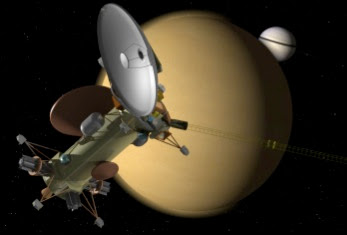
Why? Because it is exotic and beautiful and offers just the right amount of challenge. It has the potential for really good science about interesting things like where did life come from anyway? And hey, you've got to love the idea of ballooning around an alien moon. I clearly do, much to my distraction from real political issues!

Its a bandwagon that's easy to get on, and the two major space agencies (NASA and ESA -- I don't count China because they are merely showboating and NASDA and the individual European nations couldn't afford something like this and Russia is, well, Russia) have both proposed multiple missions to the Saturn system as a follow on to the still-active Cassini.

Almost all of them involve some degree of romantic technology: solar electric propulsion, aerocapture, ballooning, multiple-satellite tours. All these missions are compelling and I find myself falling into that perpetual habit of comparison shopping. Hm, here I am at Target, in the Space Missions aisle, trying to pick which Saturn/Titan mission I want to buy...

Pick it up, carry it to the counter, swipe your Visa card for the 3.2 billion dollars (imagine the Alaska Airlines miles I'd get with that!).

And so now, in order to assist all of you in selecting the Saturn/Titan exploration program that is best for you and your family, I present the following overview of the different products on the shelf.

TiPEx -- the Titan Prebiotic Explorer, is one of the oldest and most exotically romantic missions. Using solar electric propulsion and a quick dive inside Venus' orbit to pick up velocity for the long run out to Saturn, it also employed aerocapture into the thick Titan atmosphere for arrival. Both of these count as "sexy" in the minds of deep space exploration dreamers. They smack of science fiction and are technologies that the established space agencies have traditionally shied away from. For, in some ways, good reason. Aerocapture is, in particular, tricky: flying down a narrow corridor through the atmosphere of a distant and largely unknown world. Spooky stuff, the kind of stuff that causes probes to pass into radio shadow and never emerge.

That said, the TiPEx study also involved an unusual approach to the missions core payload, a helium/hot air balloon hybrid. TiPEx viewed the orbiter as secondary, carrying only a cloud penetrating radar, minimalist camera, and some radio science experiments. Otherwise, it was primarily a data relay platform for the big balloon with its gas chromatograph/mass spectrometer, radar, sounder, cameras and NIR spectrometer, and atmospheric science instruments. The drawback of a balloon -- the lack of ground truth -- was overcome with a sampling harpoon. While unable to actively hover, the balloon could never the less fire one of a dozen sample collection probes while drifting a few tens of meters over an interesting area of the surface. Tricky flying, for a robotic probe operating too far away for real-time human intervention.

On the whole, while daring, TiPEx was probably a little too adventuresome for the powers that be. After the failures of Mars Orbiter and Mars '94 and the near fiasco of the Huygens probe, space agencies around the world seem to have decided to pull back a little -- recognizing that sometimes discretion is the better part of valor and that an assured science return is worth greater expense or greater cost. And so, while exciting, this attempt to do a lot with a small but exotic mission seems destined to remain a paper study.

Never the less, the ideas of SEP propulsion and aerocapture remained strong. The next several studies, also performed by NASA's Jet Propulsion Laboratory, continued to use elements of this combined approach. A low cost "Billion Dollar Box" study did little but prove that valid Saturnian science could not be achieved for less than $1.3 billion -- and truly effective science would require at least $2.2 billion. It skipped the SEP exotica for chemical mid-course guidance but went for the aerocapture approach.

Finally a very well developed "Flagship Class" mission study put together a little bit of everything. Other than eschewing SEP boost, it went for all the rest that Titan dreamers hoped for: aerocapture to Titan orbit and not just a balloon but also a lander to obtain ground truth samples. This proposal reads as a real Cadillac effort, ambitious proposal and limited by launch vehicle constraints (Atlas V 551) and little else. The instrumentation package is well described and detailed, the hardware reasonably well defined and conservatively specified.

Meanwhile, on the other side of the pond, the often more ambitious (and innocent) planners of ESA were penning their own Saturn probe. TANDEM -- apparently an acronym standing for, in some language, Titan and Enceladus Mission, was a true blue sky effort including a Titan balloon, a Titan ground truth lander, and possibly multiple microprobes for icy Enceladus. Even more than JPL's Flagship, this seems a proposal in the "let's see what we could do..." mode of thinking. And, as with most of such proposals, it didn't last long when exposed to the corrosive light of day.

It did, however, open eyes to a new idea -- abandoning the almost obligatory aerocapture in favor of the seemingly retrograde use of chemical propulsion for capture at the destination. This wasn't out of engineering conservatism, but stemmed from the realization that a multi-stage capture, first into Saturn orbit and only later around Titan, offered significant science benefits. Such a "tour" would only be possible with chemical propulsion but, ironically, also enabled the use of this more conservative approach by a ballet of delicate flybys of various Saturnian moons to shift the spacecraft's orbit until a final, comparatively small burn for Titan orbit entry.

Picture 2.jpgNow sketched out as a cooperative project -- and bearing the thoroughly unattractive and clearly designed-by-committee name of Titan/Saturn System Mission -- TSSM would involve a NASA provided orbiter and a European provided lander and balloon.

That's the version I've put in my shopping cart. Not just because it is the latest, but because of the spectacular ability to generate a LOT of science. Not just one moon, but during the tour the fascinating planet of Saturn itself, the beautiful ring system, the icy and dynamic Enceladus, and the various other smaller moons.

I just hope that Bank of America will up my credit limit, because the bill's going to be a big one.

Is this any way to run a robot?


Now I don't mean to speak ill of the very hardworking folks behind the Mars Phoenix lander, but I"ve watched the events of the past few weeks since the landing of Phoenix with an increasing conviction that they don't quite know what they are doing.

Compared with the smoothly methodical -- measured but adventuresome -- progress of Spirit and Odyssey, Phoenix appears a bumbling but lucky buffoon. WIth a sampling system that appeals to require soiling itself, Phoenix is now covered in piles of dirt. Suffering from the mysteriously "out of specification" doors, the critical TEGA looks more like a science fair project that requires the flick of a hopefully-not-noticed finger to operate correctly when the teacher comes buy to issue grades and ribbons.

Now not all of this is necessarily the fault of the engineers and scientists. The soil of mars isn't what was expected. Apparently more couscous than dry flour. The instruments were built, mothballed, and updated over a decade's lifespan.

But such brittle design and superficially haphazard operation causes me to raise an eyebrow. If you're going to an alien world, to an ice pack region that has never before been explored. why make assumptions about the quality of the soil> If you've got years of time to re-test and review your instruments, why should there be unexpected questions? Instead, all the focus was on the EDL systems, the (eventually scrapped) guided re-entry system, the range finding radar, the braking rockets, the potential for interference from the descent imager that eventually cost the project any contextualizing airborne photographs.

This last is a problem I see all too often -- a fixation on the expected or known problem to the detriment of areas unsuspected of posing challenge. Engineers knew that there was a potential for Phoenix to suffer descent phase problems. That's what did in the similar Mars Polar Lander almost a decade ago.

But the other aspects -- at least from my outsider's perspective -- seemed to be taken for granted. TEGA had been built for another mission and was, therefore, regarded as a proven system. The sample delivery system had been developed for another mission and was, therefore, regarded as a proven system. The fact that those other missions never flew or crashed before any operating experience could be gained seemed easy to ignore.

Another classic mistake was made -- though I have yet to hear of any repercussions -- that of modifying existing instruments. Kludging together the proven and the novel seems a simple solution but often reveals itself a short sighted decision compared to the superficially greater challenge of a clean-sheet design. Such was the downfall of the first Ariane V launch -- in which reused software proved incapable of dealing with a novel dynamic environment and the first Delta III launch which fell to a similarly explosive fate for similar goals of false economy.

But part of the problem is just the whole messy nature of the thing. Anyone who knows me recognizes that there is a seed of fussiness that occasionally leads to inappropriate acts of dishwasher loading during social situations. But I'd like to think that this doesn't necessarily carry over to space exploration. No one is there to clear Phoenix up with a portable Dyson or some Clorox wipes. So given this fact, I would expect a design (and operation scheme) that perhaps more carefully guarded the danger of sloppy sample handing leading to contamination or interference.

I look at that sample door and can't help but wonder if, despite the much discussed out-of-tolerance components, it might not have opened a little further without that pile of dirt on top. And there is the microscope...with the same open-funnel-on-top sample collection system that prevents any ability to examine a single scoop of dirt through multiple analytical techniques. And WetChem (a name that always makes me feel vaguely dirty) suffers the same problem of preventing multi-technique analysis, an approach that is the heart of any regular systematic identification of an unknown.

The idea, again, was simplicity. Why have a complex enclosed sample distribution system, "just another thing to break" as my dad would say, when the same arm that is essential for sample collection doubles for sample distribution? But if this simplicity costs data or prevents the full us of the instrument suite, then it has failed.

So we'll see what Phoenix does for us. The data coming back is not without value. The pursuit is worthwhile. But has a false effort at economy or naive quest for simplicity jeopardized the overall return in the manner of CONTOUR, Mars Orbiter, the original design for Dawn, or (lest anyone sense a national bias here) Beagle 2?