Pages

Friday, January 16, 2009

How do you dead-stick an Airbus?

Well, for starters, you have Cap' "Sully" Sullenberger at the controls. From what I can tell, yesterday's amazing A320 ditching in the Hudson was a case of having the right guy (Sully) in the right place (left hand seat of flight 1549) at the right time (shortly after the impact of a large number of Canadian Geese).

Oh, and regarding those geese, I knew I never liked those things...

Anyhow, as the relevant authorities do their investigative work and aviation-centric press writes its stories (with more insightful information that the one observer, quoted on CNN, who seemed to take pains to point out that it "was not a seaplane.") I thought I'd put a little guidance out there for anyone who wants to try to ditch an 'Bus of their own. You know, on Microsoft Flight Simulator, X-Plane, or the like. If you hold a current ATP certificate and are carrying people in the back, please do not attempt these procedures unless you have recently made the acquaintance of a large number of geese.

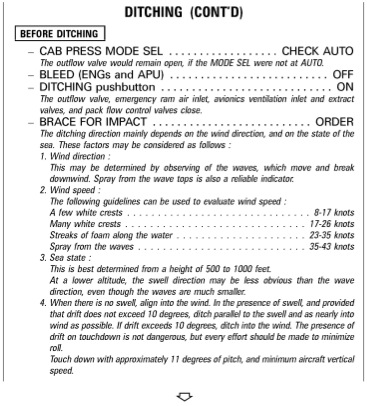
Actually, in all seriousness, these are the dual engine failure and ditching drills from a real A320 flight manual -- the drills that would have come in to play yesterday at about 3,000 feet over NY. If you look at Flight International's reconstruction of the aircraft's flight path, it looks like the following unfolded over the span of about four minutes time, beginning at an altitude of about 3,200 feet.

TO help set the scene, he's a snap of the relevant sectional chart, courtesy of the fantastic http://www.airnav.com/airport/KLGA and skyvector.com.

Picture 6.jpg


Flight 1549 took off from LGA heading to the Northwest. It is easy to see why Captain Sullenberger chose to head to TEB -- it was more-or-less a straight shot with no need to turn. But given the alignment of the Teterboro runways, he'd have had to aim for a point quite a bit to the South or Northeast before turning to align with the runway (just making it to the relevant dot on the map doesn't count when you've got an aircraft to land). All that maneuvering takes energy, which is exactly what he didn't have.

Anyhow, the Hudson proved conveniently close and full of helpful (in, I'm sure, a gruffly New Yorkish sort of way) ferry boat captains.

And, as promised, the relevant procedures and hopefully a little (if coldly technical) snapshot of what was going on in the cockpit. Airbus' manuals are dry, technical, and descriptive. More Germanic than Gallic, I find, lacking the sort of wry humor that occasionally pervades the worst-case sections of flight manuals (the Space Shuttle manual is, oddly, a great example of such humor). I do, however, like the blunt statement of the obvious at the top of the dual engine failure list: LAND ASAP.

Picture 1.jpg


Picture 2.jpg


Picture 3.jpg


Picture 4.jpg


Picture 5.jpg


Questions and comments, if you got 'em, to the blog or to strauss(dot)nick(at)gmail(dot)com. Damn spammers, gotta' be all cagy now-a-days.

Go get 'em, Captain Sully!

Saturday, January 3, 2009

A Rational, Science Based Space Program - Part 1

This blog entry was originally to be titled "An Open Letter to the President Elect" but, for two reasons, I retitled it. First off, the multi-part thing just didn't fit the open letter format. I mean, did I really think Obama would read my blog? And more than one entry, particularly at the current pace of production? No way.

Secondly, I wanted to make it clear from the outset that this wasn't a political entry. Not really, at least. It wasn't going to have anything to do with cabinet posts, inauguration day speakers, or any of the other stuff about which people seem inclined to express their opinions at the president elect.

Oh, and I find the phrase "president elect" horribly ungainly. Which, given my sentence structures, is probably saying something.

What this blog is about is space science. And, therefore, at least a little bit about politics. Because, while I will generally steer clear of the whole Griffin-at-NASA thing, a certain degree of politicality is inevitable. But more on that later.

This blog is a suggestion, a plea even, for a well thought out, science based space program. I have some very specific thoughts on what this means -- right down to what missions should get funded. And, frankly, I'd like to be put in charge of this project. Just give me $24 billion. I'll lay the plan out.

As I worked on this entry, I realized that if I wanted it to avoid turning in to a space geek's fantasy laundry list of rocket launches and space missions, I'd need to make the underlying rational clear. And that forced me into a length that well exceeded the patience of even my most devoted readers (who are family members, so you should get the idea I could go on about this for a very, very long time, particularly if whiskey is involved). So today we begin with Part One: what exactly do I mean when I talk about a science based space program.

Well, and I say this partially because I love building suspense, it'll take some time to get there.

I posit that there are five reasons for space exploration. These reasons could apply globally, to an entire national space program or effort, or to a single launch or mission. They can mix and combine and share the drive behind a particular project. An given project can see its genesis in one reason but bear fruit along another axes. Things are complicated. But five reasons is a nice place to start with.

images.jpgNumber One: Achievement
John Kennedy invoked the sense of challenge when he commissioned the high point of American space flight, the Apollo moon landings. The reason was simple: the moon was there, landing a man there was (barely) achievable, and it was a great way to try and compete with the then surging Soviet space effort. The result was a galvanizing technical (and emotional) effort, a great deal of national pride, and a moderate amount of science. Apollo was great. But it was done (to paraphrase Sir Edmond Hillary) "because it was there."

Number Two: Function
Spy satellites, communications satellites, weather satellites all do useful things. They may not be glamorous, and they rarely break tremendous new ground, but they get the job done. Workmanlike, they bring home the results, civilian, military, public sector or private sector.

Number Three: Enabling
Sometimes you do something so that you can actually do something else. Sometimes you spend a great deal of effort building a jig. The jig itself is uninteresting, but the chair that it yields is beautiful. The American Gemini program did this in space -- it taught us how to fly, spacewalk, maneuver, and troubleshoot in the vacuum of space. The Space Shuttle was marketed as a utility truck much along these lines once, and the current International Space Station is often sold as a tool to help us learn how to survive and construct in space.

Number Four: Exploration
Gene Roddenberry, this is your moment. The bold going. Or going boldly. The Pioneers and Voyagers, heading off into regions unknown, to see what has never been seen before. Details are not important -- for every byte of returned information contains precious sights of the here to fore unknown.

Number Five: Science
The explorers set forth with no questions, only open eyes. The scientists set forth with questions, ideas, and theories. They seek explanation and understanding, they want verification or refutation, they require detail and precision. They may find the unknown or unexpected, but they set off not with an empty mind, but a mind full of questions.

Alright, so those are my five. It once started as three, but Enabling and Function appeared as late additions. None of these descriptions are intended to be praising or critical, merely descriptive. For all things can be good in the right time and place. And what, then, is good at this time and place?

Well, let's take a look at Achievement. That one, basically, is politics. It is about doing something (or doing something before someone else does it) for reasons related to motivation, goal setting, national pride, international relations. I am not a politician and do not pretend to a degree of competence or awareness of the full complexities of the international arena beyond that of the average moderately well read adult. And so I check out of this one. Politicians, make your choices. But this is not an area where I will make the call.

And with that goes manned space flight. Sorry, everybody. People aren't part of my program. They are too expensive for what you get back. Great thrills, beautiful video, and a truly motivating and empowering feeling when done right. But the price and the risks are too great to justify human space flight for any reason other than that of Achievement (or politics).

Function is pretty good -- but not with people. I'm tired of the circular logic of a manned space program that justifies its own existence with the endless loop of providing more understanding of how to allow humans to fly in space. Why? What is the point? What is the point of learning how to get people to survive in space for two or five years unless you are really going to Mars. And let's get real. Not happening, that one.

But functional unmanned space flight is doing great. It is very well established by government, military, and commercial agencies.

Exploration is another noble reason that struggles in today's reality. Exploration is about the low hanging fruit in some senses -- you have so little information about something that you are excited to get even a basic glimpse. The implication is that the technological act of getting there is where the challenge lies. Problem is, we've got all the good getting in this regard. Except Pluto and, thank you Allan Stern, New Horizons is on the way and doing great.

Which leaves us science. The serious quest to understand our universe (and a few other things). Not helter-skelter pursuit of goals that look or sound good. But the systematic quest for the deep, subtle, and profound knowledge of how things work. The universe, life, and our planet.

And so from that final remaining reason, we must move on. But first, to review:

Achievement: too political, too expensive (if manned)
Function: already well handled by others
Enabling: only worthwhile if stepping stone to legitimate goals
Exploration: most reachable stuff has been done
Science: bingo!

images-1.jpgSo what is this science based program supposed to be about, then? How do we make sure we stay on that particular target and don't go wandering into another one. Well, for starters, some wandering is going to happen. Apollo, while a clearly achievement based project proved to be very enabling and did a great deal of exploring. So we accept that.

Secondly, devise a clear definition of what sort of goals we want to achieve. Write these goals down in large letters. And make sure that anything you pick fits within this charter.

Now, for my sake, I admit that this was a case of backing into a definition. Because honestly, I found this was one of those things that, like the old joke about pornography, I may not be able to define, but I know it when I see it. But I wrangled and experimented and finally defined myself a set of three goals that express the ideals of the rational, science based space program. In forming this definition I wanted to avoid the trap of forming a laundry list, a long rambling list of commas and (God forbid) semicolons. I wanted a single, elegant, coherent statement. If you can't break it down (whatever it happens to be) into a single sentence, then you have a problem.

To understand our universe, our planet, and the place of life in the cosmos.

And there you have it. One sentence and with fairly few commas. It works better with three, though:

Understand our universe, its origin, evolution, and nature.
Understand our planet, the forces acting on it, and the changes it is undergoing.
Understand the origins of life, life-bearing systems, and the potential for life to exist elsewhere in the cosmos.

I also gave myself a tidy (if arbitrary) limit of ten missions that I could fly. They should all be achievable by the end of the next decade (2020). And they should fit within a budget of $20 billion ($2 billion each, on average) including launch, support services, margins, and a well crafted outreach and education program.

The resulting ten missions span a range of deep space explorers and earth orbiting environmental probes. They include telescopes, radars, balloons, and sample return capsules. They are based on missions that NASA or ESA has studied or is studying for implementation within my timeframe. Later entries will go into further detail, but here is a preview.

A probe to retrieve and return a pound worth of cometary matter to Earth -- providing a potential insight into the building blocks from which our solar system (and life on Earth) arose.

A probe to explore the outer layers of the Sun, diving into the solar corona to better understand the mechanisms responsible for transporting the Sun's energy and triggering solar storms.

A probe to the complex Saturn system and its moons of Enceladus and Titan, both potential sources of rich and exotic prebiotic chemistry.

A satellite to study chemical processes in the Earth's atmosphere with unprecedented spatial and temporal resolution to better understand the mechanisms that generate, transport, and sink atmospheric constituents (including pollutants).

A satellite to measure the shape and texture of Earth's surface, providing increased awareness of geologic processes, moisture content and migration (including ice thicknesses), and biosphere composition.

A satellite to observe the Earth's land and seas as well as atmospheric images-2.jpgwater and aerosols to better understand weather cycles and the chemical and biological activity of the deep sea and coastal regions.

An observatory to monitor the faint temperature and polarization shifts in the faint cosmic microwave background, probing for traces of the first infinitesimal moments of the universe's history.

An observatory to search for rocky worlds in 300 nearby star systems and to characterize their masses, orbits, temperatures, and atmospheres - including potential markers of biological activity.

An observatory to map thousands of square degrees of the sky to a depth and detail only previously seen in pinpoint images less than 1/300th of a square degree, yielding insight into the evolution of the universe and the nature of dark energy.

An observatory to image the most dramatic and high energy sources and events in the universe in x-rays, probing the physics of these challenging points where quantum theory and relativity collide.

As for the rest of the details, I'll have more for you soon.

Tuesday, November 25, 2008

Does this surprise anyone?

Eclipse Aviation Files Chapter 11

Well, does this surprise anyone?

Naturally, they are blaming the current economic crisis. Now I don't want to go saying that aforsaid economic crisis is some sort of small time setback, but I'd like to make the point that when the going gets tough, the tough had better have decent business plans. And when you have a fundamentally flawed model -- and are selling a fundamentally flawed product -- and have fundamentally flawed management and customer relations practices -- you are basically screwed no matter what happens.

Eclipse1.jpgEclipse was a company that might have survived a few more years had the original timing worked out. They'd have launched towards the beginning of the boom and managed to get a few hundred products delivered before the carpet was so cruelly yanked out from under them. Odds are a lot of those little jets would have been repo'd, but that's another story. But I think that a longer life (and more sales) would only have lead to their death by other means -- the fundamental design, production, QA, QC, and customer services issues would have had enough time to come (further) to light and killed Eclipse off just as surely, all be it more slowly, than the economy tanking appears to have.
It is a bit like the arguments that circulate around assisted suicide or on nighttime crime dramas: if you take a life of someone who is going to die soon enough anyway, how much of a murder is it, really?

The missed payroll two weeks ago was the final warning bell, the tocsin announcing that the end was mere days away. I am sad for those employees of Eclipse who were toughing it out until the end, hoping that the dream had been built upon firmer footings. But I've been part of a business plagued by systemic strategic, ethical, operational, and managerial issues just like Eclipse. And you could sort those of us at that operation into two camps: those of us who knew the place was a s&*% hole and were looking for a way out and those of us who knew the place was a s&*% hole and were too scared to take action. Either way, each person's destiny was came down to their own active or passive decisions and pointing at the company's flaws will only get you so much pity, not when the writing is on the wall for anyone to see.

So my best wishes to those of you at Eclipse who were trying to keep the dream alive -- and when things rebound and lessons are learned, I hope to see a new product of your efforts in the air. And before anyone goes pointing this out to me -- I know that Chap'11 isn't the true death of a company. Many concerns have emerged, successful and vibrant, from protection. But it is such a dramatic indicator of failure at so many levels that in this case, I do think, it spells the end of Eclipse as we have known it.

But in the meantime, as ever, aerospace remains a harsh mistress.

Monday, November 24, 2008

The fun of bringing light to the dark -- metaphorically

So I decided it was time to give politics a rest. This isn't, after all, a political blog. It is a blog about odd, rambling things like wind tunnels and cocktails and cipher systems. And so, after the quiescent period following the election, as I slowly bring The Noodlebook back to life, I thought I'd get it going with a little science.

Dark energy, to be precise.

And not even dark energy as such because, let's face it, both my own small skill as an elucidator and the period of time I have available for this endeavor are dramatically inadequate for tackling so deep a mystery. Instead, in the classic talk-about-the-talking postmodernism of blogs, my attention turns to the investigations seeking to understand this phenomena rather than the phenomena itself.

I have, after all, always been much more of an experimentalist than a theoretician.

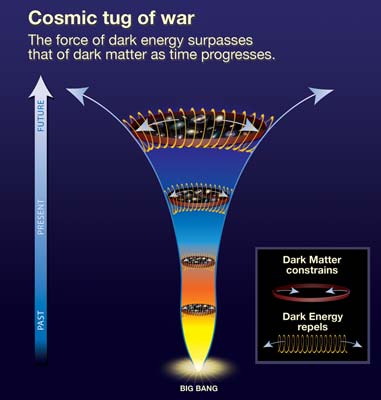
But to recap, dark energy is a postulated force that would explain some rather odd behavior of the universe. The oddity in question (for there are several oddities about our universe that require postulated things to explain them) is that the universe seems to be expanding at an ever increasing rate. Now that the universe is expanding is not at all odd. We've known about this since Edwin Hubble, a man brilliantly characterized as a "large mass of ego" by Bill Bryson, noticed that all the galaxies in the universe are expanding away from each other. Subsequently, a series of theories beginning with the "big bang" and moving on to modern inflationary cosmology have homed in on the idea of the universe originating at some sort of very small beginning (there are a few variations) and expanding outward from some sort of initial impulse (again, there are a few variations).

This is all fine and good and if you want some ideas about the how/why on that it won't surprise anyone that I now recommend Brian Greene's The Fabric of the Cosmos. But this expansion should be slowing -- as the shared gravitational attraction of all the, well, stuff in the universe gathers together and pulls on itself. And for a few billion years, it appears that it did. But then a few billion years ago, the rate of expansion began accelerating again. There is no good reason for this, not with the rule that we've been playing by.

dark_energy_diagram.jpg


It is as if, to invoke a classic Feynmanism, we were watching a chess game, thought we'd got the rules and moves pretty much figured out, and then someone castled. Uh-oh, what the hell was that?

Since then, cosmologists, astrophysicists, particle physicists, and plain old ordinary physicists have all gotten in on the bandwagon to try and explain why. The lure of being the first to explain a new (or dramatically revised) physical force is a pretty big one!

Alright, enough of that back-explanation. I said that actually trying to explain dark energy was beyond me. Oh, but it is different from dark matter. I know. They could have come up with some more varied names. Like "The Smuckers Effect" or perhaps "The Universal Choo-Choo." Either one might have been better.

So this dark energy stuff, whatever it is, is suddenly pushing the universe apart faster and faster. Or not so suddenly. Or it remains constant or decreases as a quadratic function while gravity decreases as a cubic function. Sorry. Got distracted again. The point is, we have no idea what this force, this dark energy, is. We can only observe what it does. And that makes it a wonderful place to study and understand the interplay between observation (experiment, if you like) and theory.

Science proceeds, in an idealized and perfect world, as a series of iterative steps. Someone observes a phenomena (say the increased rate of expansion of the universe). That person (and a few others) say "Damn, we didn't expect that!" Everyone then retires to their chalkboards and starts thinking of theories to explain what is causing this phenomena. The theories will span a broad range. Some might involve zero point energy, others extra dimensions, still others giant turtles. As the theorists theorize, the experimenters begin to contemplate the next round of experiment or observation (I think of experiment as an active act -- where we do something, such as at a particle collider -- while observation is a passive act where we take data on what the universe is already up to -- as with a telescope).

Theorists and experiments/observers are different. The former are the ones with the unkempt hair, the latter the ones with the dirty clothes and coffee addictions (particularly in astronomy).

Anyhow, while the theorists are using their imaginations and running the numbers, the experimenters/observers are doing their thing and building the next generation of machines. What proceeds then is something like a lottery. Or perhaps a reality TV show, though I doubt "Survivor: CERN" or "America's Next Top Scientists" or "Theorizing with the Stars" will take off anytime soon.

Any good theory brings a few ingredients to the table. It must offer an explanation for why the phenomenon under consideration occurs. It ideally should offer a mechanism to explain how it occurs. And it should provide some sort of mathematical formula that can fit the observed data to a high degree of accuracy. Lastly, that mathematical rigor should allow for some degree of prediction of as yet unobserved phenomena that can test the accuracy of the theory. This prediction might simply involve taking the measured predictions to a few orders of magnitude more precision. Or it might involve a wholly new physical manifestation. Either way, it provides some way of telling if the theory will have the winning number come lottery time -- the return of experimental results.

We go round and round like this. The results from each round of experiment feed the next round of theory. The predictions of a given round of theory guide the direction in which the experimenters/observers turn their searching. Rarely, however, are things so precisely beautiful as this, like turns in a board game. Usually, after a while, everything gets all out of synch and the experimental and theoretical processes get all overlapped.

But dark energy is new. It was accidental in a wonderful way, and the demands of further experiment have allowed for a long and fruitful phase of theoretical contemplation. And now the experimenalists are about to have their day. And by now I mean in about eight years, because that is how long it takes to get a space mission from budgetary contemplation to launch pad. And then a few more years of taking data.

Science is for the patient, these days.

This whole process of theory-experiment (or observation) is crucial to the scientific quest for understanding. It always galls me when people talk about how scientists don't actually know anything -- they just have a bunch of guesses. This points to a fundamental misunderstanding of what a theory is. It isn't a guess. If it was, there might be some credence to the idea of giant turtles playing a role in dark energy. Rather, a theory is an educated attempt to explain a phenomena. It is a look by a very experienced observer at a set of behaviors, an assessment of what those behaviors might mean, and an attempt to predict what they might mean for the future.

We all form theories all the time. When we spot a car swerving erratically while driving at 2am, we say "Woah, look how that dude is driving. I betcha' he's drunk. Look out, he might miss that turn..." We observed phenomena, offered an explanation, and attempted a prediction. The depth of prediction can be tricky. If we only say "This driver will keep swerving around" it may not eliminate other possibilities such as looking for something he dropped, having an epileptic seizure, or making out with the passenger. But it is entirely possible that a drunk will in fact make that next turn too. Or never intend to take it.

The scientific process is nothing different. It is not (and does not pretend to be) a fixed rulebook. It is an evolving set of understanding of the universe. Science is not a set series of answers as it is so often (and so wrongly) presented. Rather it is a process, a pursuit of those answers.

And so when more accurate measurements gave rise to results that disagreed with the predictions inspired by Hubble's results, the result was not joy and frustration, but excitement at the opportunity to solve a new puzzle. An Asimov quote that those who have read email coming from my work address will recognize summarizes this mood better than anything:

The most exciting phrase in science, the one that heralds new discoveries, is not "Eureka!" but "That's funny..."


And now the prospect of dark energy is out there, proposing a grand enough prize and an exciting enough pursuit that seemingly everyone is getting into the game. Established scientists, cranks, those hawking ideas from the fringe, conspiracy theorists, random posters on the Internet: each one has some idea, spun slightly to reflect individual specialities and biases, for what might be at work.

The observational guys have been at it just as enthusiastically, constantly devising new approaches to reflect the latest ideas of the theorists and the latest technological developments in measurement apparatus. Dark energy isn't something we can test in a laboratory with a dark-energy-ometer or create with a steel cased apparatus connected to several thick cables. It acts, by all accounts, over vast distances and only manifests to a measurable degree when other forces (namely gravity) are at their most feeble. And so an earth-bound measurement (even if we knew what to look for) seems doomed to be swamped by noise.

This results in observatories. For various reasons, these would be observatories best sited in space, at the L2 point about a billion miles from earth, where it is dark and cold and not much gets in the way. The idea would be to observe, with great precision, the distances and recessional velocities of several thousand (or million) objects in the middle distance of the universe, the distances over which dark energy starts to manifest -- out to about twenty billion light years (117,580,000,000,000,000,000,000 miles).

A few approaches have shown up. The first involved hunting for something called Type 1A supernovae. These moderately rare explosions function through a well understood mechanism that has the handy feature of producing a reliably predictable brightness. The result is something called a "standard candle" -- an object of known intrinsic brightness which allows the estimation of its distance by comparing that source brightness with the observed brightness. That's good -- and Type 1A's are how this whole dark energy thing got started -- but it turns out it is not good enough.

Clouds of gas and dust can get in the way and it always is possible that we don't understand the Type 1A quite as well as we thought we did. So more recent approaches to understanding dark energy have tried to invoke several different techniques of measurement. Acoustic Baryonic Oscillations (I'm still trying to figure out what those are, but they sound really interesting), weak lensing, and a few others have all surfaced. The result is that any dark energy space mission that actually gets flown will end up as a fantastic multi-disciplinary observatory, quite different from the specialist that was originally envisioned.

Picture 14.jpgThe glory of all of these approaches, and of all of the missions that seek to imlement them, is that they will conduct their work through massive "wide and deep" surveys. Taking vast numbers of long exposure images across a large area of the sky, in other words. This is the advantage of a dedicated mission -- Hubble or the James Webb could do the same science, but are general purpose instruments contended over by the entirity of the vast astronomic (and astrophysic) community. But a dedicated mission, running a pre-planned scheme of observation, can produce the staggering amount of data that is necessary for the statistical analysis upon which dark energy studies must be based.

But this vast survey, while intended to specifically test a signle scientific concept, will also have enormous implications for the rest of the community. Currently, we stare through straws, looking across the vast night sky to find things that are interesting. Sometims we do so by chance, but more often we do so by looking at areas that we've already identified as interesting. The terabytes of data coming back from SNAP, DESTINY, ADEPT, JDEM, SPACE, Euclid, or whatever mission or missions end up flying will end up producing an astronomic and astrophysic legacy ready for the picking. A generation or more of astronomers and astrophysicists will mine this legacy to confirm and clarify their theories and hypotheses. And, here and there, they might discover something completely new, something entirely unexpected, something funny, and start the whole glorious process over again.